How often should coolant be changed? Learn how long coolant lasts, the warning signs, what affects the price and when to act. Ash Road, Aldershot.
Most drivers think about engine oil, tyres and brakes. Very few think about the bright liquid sitting quietly in the plastic tank under the bonnet, right up until the temperature gauge climbs on a hill, steam rises at the side of the road or the heater blows cold on a frosty morning in Aldershot. By then, the damage has often already started.
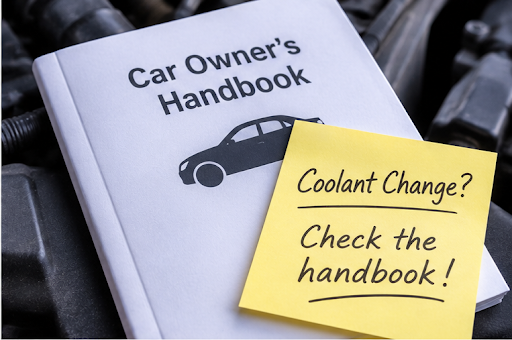
So how often should you change your coolant? There is no single answer for every car, because the interval depends on the type of coolant, the manufacturer’s recommendation and the way the car is used. Some older coolants need replacing every couple of years, while modern long life coolants can last much longer. The only reliable source is your handbook, and the safest habit is to check the condition of the coolant long before it becomes an emergency.
This guide explains what coolant does, how long it lasts, the signs it is past its best, what happens if you use water instead, what affects the price of a coolant change, whether you can do it yourself and how to look after the system. If a cold snap is on its way, the sections on winter are the ones to read first.
Quick Answer
How often to change coolant starts with one question: which coolant is in your car? The answer depends on the type of fluid, the age of the car and what the manufacturer specifies. Some drivers call it radiator fluid or antifreeze, but the advice is the same. No single number fits every vehicle, so the type of coolant and the maker’s schedule always come first.
What Does Coolant Actually Do?
Coolant, also called antifreeze, is not simply water with a dye in it. It is a carefully balanced mixture of water, a glycol base and a pack of additives, and it does four jobs at once.
First, it carries heat away. The combustion inside your engine produces enormous heat, and the coolant circulates through the engine, absorbs that heat and carries it to the radiator, where the airflow cools it down again. The same fluid warms your heater matrix, which is why a cold heater can be an early clue that something is wrong.
Second, it stops the system freezing. Water expands when it freezes, and that expansion can crack a radiator, split a hose or even damage the engine itself. A correct mix of coolant and water stays liquid far below zero. A mix of roughly half coolant and half water commonly protects down to around minus 35 degrees Celsius, although the exact figure depends on the product.
Third, it raises the boiling point. The cooling system is pressurised, and coolant helps it cope with high temperatures when you are crawling through traffic in Farnborough or hauling a heavy load up a hill. Fourth, it fights corrosion. The additives coat the metal surfaces inside the engine and radiator and lubricate the water pump seals, which keeps scale and rust from building up.
How Long Does Coolant Last in a Car?
The question of how long does coolant last in a car makes more sense once you know why it wears out. The glycol itself holds up well. It is the additives that get used up. They gradually deplete as they protect the metal inside the engine, and once they are gone the coolant becomes more acidic and starts to attack the very parts it was meant to protect. How long coolant should last in a car depends on how quickly those additives run out.
Several things speed that up. Heat cycles, repeated top ups with the wrong fluid or plain water, small leaks and an ageing system all take their toll. Drivers who do a lot of short, stop and start trips around Ash Vale put their coolant through many heat cycles without ever settling into a steady cruise, which can be harder on it than a long, steady run. If you want to know how long car coolant lasts in your own vehicle, the maker’s schedule is the starting point, and a test is the confirmation.
| Coolant Type | Typical Colours | General Lifespan Guide | Notes |
| Conventional | Green or blue | Around two to three years | Common in older cars, additives wear out sooner |
| Long life | Orange, red or pink | Around five years or more | Common in many newer cars |
| Hybrid long life | Yellow, turquoise, pink or purple | Often five years or more | Specifications vary between manufacturers |
Treat this table as a general guide only. Your own manufacturer’s recommendation is the figure that counts, and some cars have intervals that differ from these ranges.
Why Colour Is Not a Reliable Guide
It is tempting to match the colour of the fluid in the tank when topping up, but colour tells you very little. Different manufacturers use different dyes, two coolants of the same colour can have different chemistry, and the same coolant can look different once it has aged. Mixing incompatible types can reduce protection, and in some cases it can form a gel or sludge that clogs the system. The right fluid is the one that meets the specification in your handbook, so check the exact wording before you buy anything.
Signs Your Coolant Needs Changing
You do not have to wait for the schedule to find out whether coolant has had its day. Watch for these signs:
- Rusty, brown, murky or sludgy coolant in the expansion tank
- An oily film on the surface or a milky look to the fluid, which needs urgent attention
- White or crusty deposits around hose joints, the radiator or the cap
- A heater that struggles to produce warm air
- A temperature gauge that runs hotter than usual or climbs in traffic
- A sweet smell after a drive, which can point to a leak
- A coolant level that keeps dropping between checks
- No record in the service history of the coolant being changed, with the car well past the recommended interval
A coolant change is not only about age. If the fluid is dirty or weak, the work may be needed well ahead of the schedule. Several of these signs can have other causes, which is why a proper test matters. A technician can check the freezing point and condition of the coolant, and look over the hoses, cap, radiator and water pump at the same time.
Coolant Change Intervals by Car Age and Mileage
Many handbooks give two limits for a coolant change, a time limit and a mileage limit, and the rule is usually whichever comes first. A car that covers very few miles can still be due a coolant change, because the additives age with time and heat, not only with distance. A car that sits on a drive in Ash for most of the week can reach its time limit long before it reaches its mileage limit.
A rough way to think about it is in stages. When a car is new, the first coolant change is often a long way off, because the factory fill is usually a long life type. In middle age, many cars reach their first scheduled coolant change somewhere in the region of five to ten years, depending on the maker. In an older car, particularly one that uses a conventional coolant, a coolant change every two to three years is a safer habit, but confirm the type of fluid in the system before you assume anything.
If you bought the car second hand, the history matters. A missing record does not mean the work was never done, but it does mean you cannot be sure. How often to change coolant is hard to guess without that record, so a strength test is a sensible first step. A technician can then decide whether a coolant change is due now or whether the existing fluid still has life in it.
Drivers around North Camp and Farnborough who buy used cars often ask for this check as part of a general health check, and it is a sound way to start ownership. A local independent garage such as Ash Road Service Centre in Aldershot can test the coolant and look over the rest of the cooling system at the same time.
Heavy use shortens the gap too. Towing, frequent short journeys, stop and start traffic and hot summers all put extra strain on the system. If that sounds like your driving, treat the maker’s interval as the longest the coolant should go, not the target to aim for.
How Often Should You Top Up Coolant?
How often should you top up coolant? In a healthy system, the answer is hardly ever. The cooling system is sealed, so the level should stay close to the same mark between services. If you find yourself topping up regularly, the system is telling you something, and the most likely message is that there is a leak, even a slow one that never leaves a puddle.
To check the level safely:
- Park on level ground and let the engine cool completely
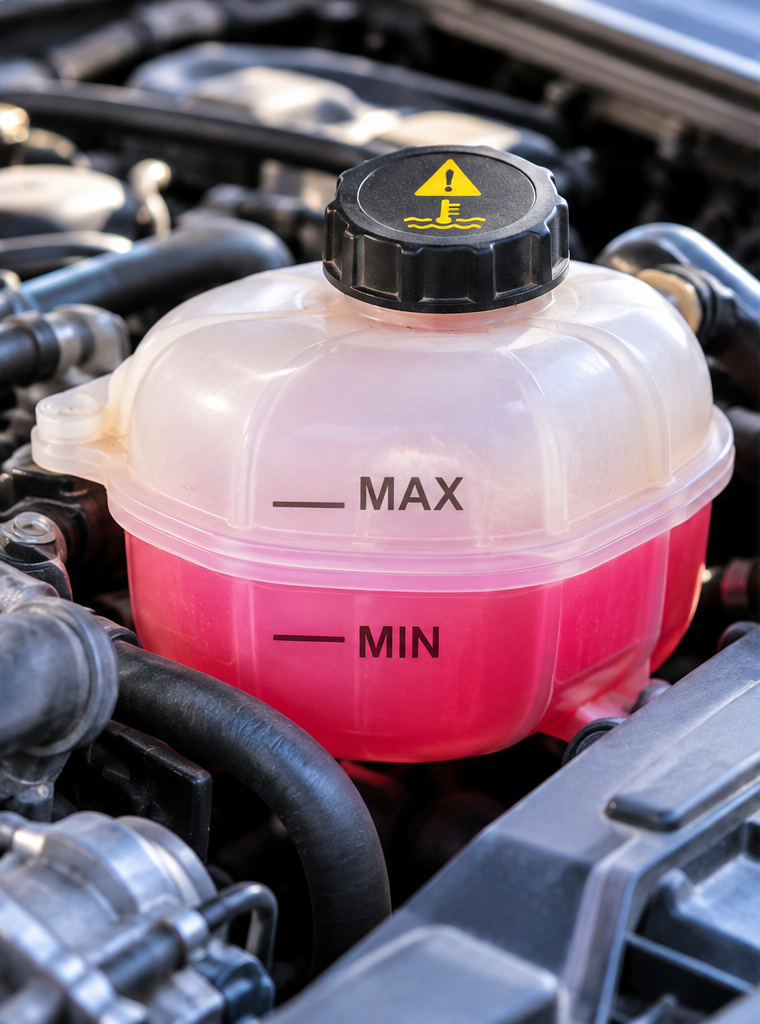
- Find the expansion tank and look at the minimum and maximum marks on the side
- If the level is low, top it up to the maximum mark with the correct ready mixed coolant for your car
- Never open the cap while the engine is warm
- Wipe up any spills straight away, because coolant tastes sweet and is toxic to children and pets
Dispose of old coolant properly, usually through a local recycling centre, and never pour it down a drain. If the level has dropped noticeably, or you have had to top up more than once, have the system looked at rather than simply adding more.
How Long Can You Use Water as Coolant?
The question of how long can I use water as coolant tends to come up when the level is low and the nearest garage is miles away. The honest answer is that plain water is an emergency measure only, to get you safely home or to a garage, and it should be put right quickly.
Plain water has none of the corrosion protection that coolant provides, so the metal inside the engine starts to rust and the passages can begin to scale up. Water also freezes at zero, which risks a cracked radiator or engine block on a cold night, and it boils at a lower temperature than the proper mix. Tap water makes things worse, since much of the South East has hard water, and the minerals leave limescale deposits that restrict the flow.
Even a single top up with water dilutes the mixture and weakens the protection it gives. After any water top up, have the strength tested and the system corrected. If you ever have to use water in an emergency, use clean water, only with the engine cold, and treat the fix as temporary.
Why Winter Is the Moment to Check Your Coolant
Cold weather is when a weak cooling system shows its hand. Coolant that has lost strength may not protect against frost, and a hard freeze can crack a radiator or damage the engine. The damage often shows up only once the weather warms and the thawed system begins to leak. A few cold nights on a driveway in Aldershot are all it takes to find out whether the mix is strong enough.
That is why a winter car check in Aldershot is a natural moment to ask for your coolant strength and condition to be tested, alongside the battery, wipers and tyres. A quick test can show the freezing point of the mixture and whether the fluid is still in good condition, and it costs far less in time and trouble than a frozen engine.
The best time to book is before the first hard frost, not after it. If you cannot remember when the coolant was last changed, treat that as a reason to check rather than a reason to wait.
Coolant Change Cost: What Affects the Price?
Coolant change cost is one of the most common questions drivers ask. The honest answer is that it varies from car to car and garage to garage, and a quoted figure that does not match your vehicle would not help you. Instead, here is what shapes the price.
- The size of the cooling system, since a small hatchback holds far less than a large diesel SUV
- The type of coolant your car specifies, as some specialist fluids are more complex to source
- Whether the job is a simple drain and refill or a full flush, which uses more time and fluid
- How easy the system is to reach, because access to drain points and hoses changes the labour time
- The method of refilling and bleeding, since some cars need special equipment to remove air from the system
- What else is found along the way, such as tired hoses, a weak cap or a thermostat that needs attention
- Whether the car is a hybrid or an electric vehicle, which can have more than one cooling circuit
A coolant change is one of the smaller jobs in car maintenance, while a neglected cooling system can lead to a radiator, water pump, heater matrix or head gasket repair. Weighing the two is why most drivers decide that a timely change is the sensible option. When you ask for a quote, ask what it includes, which coolant will be used, whether the system will be tested for leaks afterwards, and whether a written estimate is available before work begins.
What Happens During a Coolant Change?
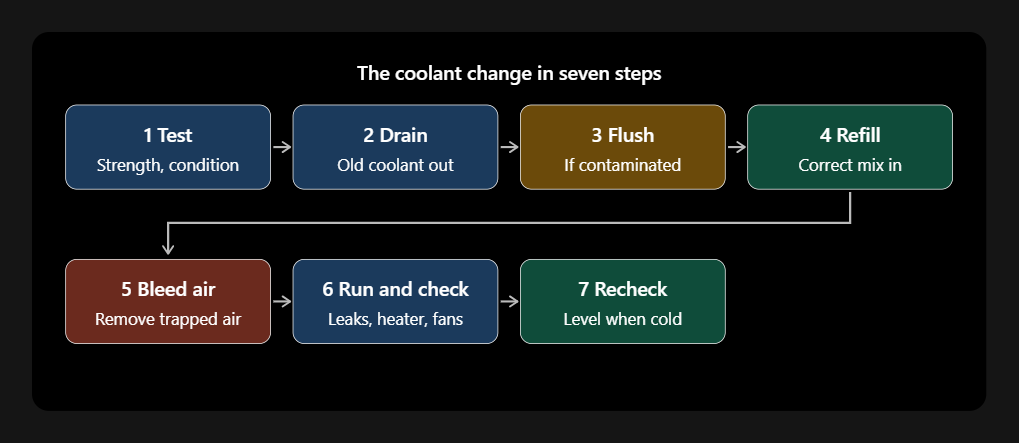
Knowing what a proper coolant change involves helps you judge whether the job has been done well. A good coolant change covers more than swapping the fluid.
- The coolant is tested first, to check its strength and condition and to record what is in the system
- The old coolant is drained from the radiator and, where possible, from the engine
- The system is flushed if the old fluid was contaminated or the system holds sludge or scale
- New coolant of the correct specification is mixed to the right strength and refilled
- Air is bled out of the system, because trapped air causes hot spots and overheating
- The engine is run up to temperature while the technician checks for leaks and confirms the heater and fans work properly
- Hoses, clips, the cap and the reservoir are inspected, and the level is rechecked once the engine has cooled
Bleeding is the step that is most often skipped and the one that causes the most trouble. A pocket of trapped air can leave part of the engine uncooled, and a car that overheats a few days after a coolant replacement has often had this step missed. After any coolant change, keep an eye on the temperature gauge and the level for the first few days.
Can You Do a Coolant Change Yourself?
It is possible, and some confident home mechanics do. It is also one of those jobs that looks simpler than it is. A coolant change at home means working with a hot system under pressure, collecting and disposing of a toxic fluid, choosing the right specification and, on many modern cars, bleeding trapped air from a system that was designed to be filled with special equipment.
If you still want to try it, work only on a cold engine, follow the handbook for the exact fluid and procedure, use a drip tray, mix to the correct strength with distilled or deionised water if a concentrate is used, and take the old fluid to a recycling centre. For most drivers, especially those with newer or more complex cars, a coolant change by a trained technician is the more reliable choice, because the strength test, bleeding and leak check are all part of the job.
How to Make Your Coolant Last Longer
You cannot make coolant last forever, but you can help it reach the end of its service life without trouble. These habits make the biggest difference:
- Use only the specification your handbook calls for, and never mix types
- Top up with the correct ready mixed coolant rather than plain water
- Check the level regularly, always with the engine cold
- Fix leaks early, since a small weep lets air in and fluid out
- Replace tired hoses, clips and the pressure cap when they show wear, because a weak cap can let the system lose pressure
- Keep the radiator front clear of leaves, dirt and debris
- Act at once if the engine overheats, rather than driving on to see what happens
- Keep a record of every coolant change, with the date, mileage and fluid type, so the next one is easy to plan
Good records are underrated. When the next coolant change is due, a note in the service book saves guesswork, and it helps a buyer see that the car has been looked after. If you ever feel unsure about the condition of the system, a quick test is far cheaper than a repair.
Common Coolant Mistakes and Myths
Cooling systems attract plenty of folklore. These are the ones that cause the most trouble:
- Coolant never needs changing. Even long life coolants have a limit, and a lifetime fill often means the life of the service schedule rather than the life of the car.
- Any colour will do, as long as it is topped up. Colour does not guarantee compatibility, and the wrong type can reduce protection or clog the system.
- Water is just as good. Water offers no corrosion protection, freezes earlier, boils sooner and leaves scale behind.
- A low level is normal. A healthy system loses almost nothing, so repeated top ups point to a leak.
- It is fine to open the cap when the engine is warm. A hot system is under pressure, and opening it can cause serious burns.
- If the gauge is normal, the coolant is fine. The gauge shows temperature, not the strength or condition of the fluid.
Conclusion
How often you change your coolant depends on its type and your manufacturer’s schedule. Older conventional coolants usually need changing every two to three years, while long-life coolants can last five years or more. Check the level with the engine cold, watch for rusty or sludgy fluid, a weak heater or a rising temperature gauge, and never rely on plain water except in an emergency.
The best time to test coolant strength is before the first hard frost. Drivers in Aldershot can call Ash Road Service Centre on 01252 342086 or find Ash Road Service Centre on Google Maps at Unit A, 151 Ash Road, GU12 4DB.
Frequently Asked Questions
How often should I change my coolant?
It depends on the coolant type and your manufacturer’s recommendation. Older conventional coolants often need changing every two to three years, while long life coolants can last five years or more. Check your handbook for the interval that applies to your car.
How long does coolant last in a car?
It varies with the type of coolant, the age of the system and how the car is used. Coolant additives wear out gradually, so a test of the fluid’s condition is a better guide than the calendar alone.
Can I use water instead of coolant?
Only in an emergency, to get safely to a garage. Water offers no corrosion protection, freezes at zero and can leave scale, so the system should be corrected and tested as soon as possible.
How often should you top up coolant?
A healthy cooling system should hardly need topping up. If you are adding fluid regularly, there is likely to be a leak that needs finding.
Can I mix different colours of coolant?
It is best not to. Colour does not guarantee that two coolants are compatible, and mixing the wrong types can reduce protection or cause sludge. Use the specification in your handbook.
Does an electric car need a coolant change?
Yes, in many cases. Electric and hybrid cars use coolant for the battery and other components, and the intervals and fluid types are specific to the vehicle, so follow the manufacturer’s guidance.
When is the best time to check coolant?
Before the first hard frost. A test of strength and condition at that point shows whether the mixture will protect the system through the cold months.