
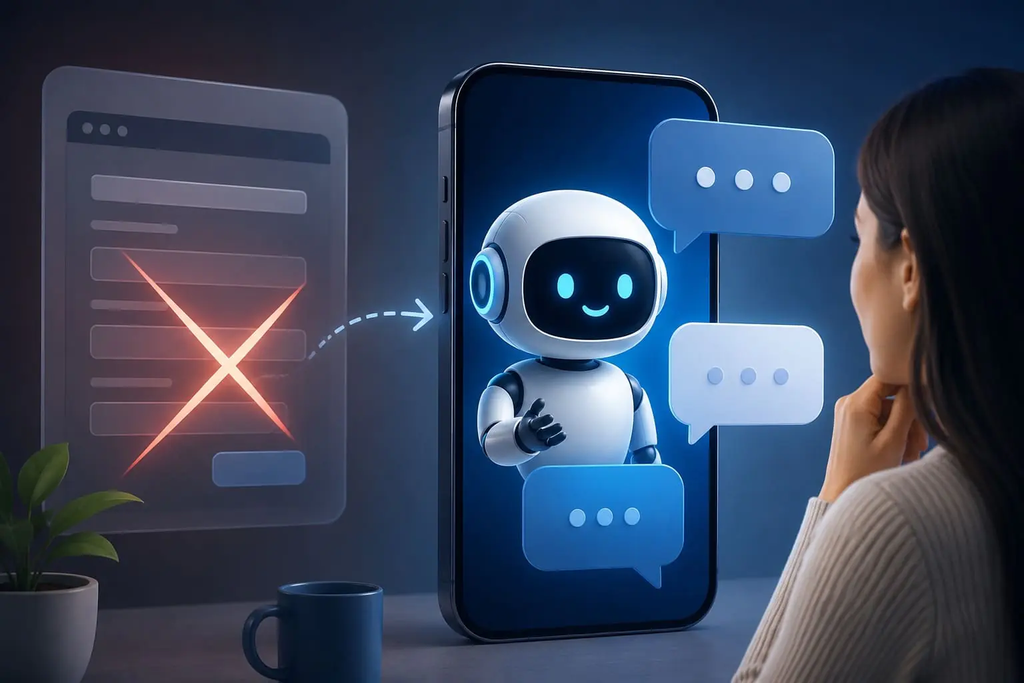
AI companions have made digital conversation a business in its own right. Chatbots can flirt, use your name and answer at three in the morning. Live performers offer something different: another person taking part in the exchange as it happens. The two experiences can share a screen layout without giving people the same reason to return.
The Rise of the Virtual Companion
The idea is not new. Replika launched in 2017 as a companion chatbot. Over time, its conversations became more personal, with some users treating their characters as partners. Voice features and customisable avatars helped turn a text exchange into something that could feel more like an ongoing relationship.
Character.AI opened its public beta in September 2022. Its founders, Noam Shazeer and Daniel de Freitas, had worked on conversational AI at Google. Users could create characters and hold open-ended conversations with them. In August 2024, Google signed a non-exclusive licensing agreement covering Character.AI’s language-model technology.
Another prominent moment came in July 2025, when Elon Musk’s xAI introduced animated companions in Grok, including an anime-style character called Ani. The launch brought a visual, voiced version of digital companionship into a widely discussed AI product. It was a striking example of the format, rather than proof that it would replace existing entertainment.
What AI Companions Do Well
It is fair to start with the strengths. An AI companion does not need a performer’s working schedule. Depending on the service, someone can open a conversation late at night, change the character’s style or return to an earlier theme. That flexibility is part of the product’s appeal.
AI characters also offer room to experiment with fictional roles. Someone can try a more confident voice, invent a setting or steer a conversation towards a particular mood. There is no need to agree a time with another person before starting the exchange.
Cost can also shape the choice. A subscription bundles access differently from a session priced around a performer’s time. The comparison depends on the plan, message limits and any extra charges, rather than a single monthly figure that applies across companion apps.
Memory and voice features can make the experience more continuous. When a service recalls a preference or resumes an earlier conversation, the exchange can feel less like starting again. How well that works depends on the particular product and its settings.
Why Live Performers Still Have a Distinct Appeal
The strongest case for live entertainment is not that software cannot produce a quick or surprising reply. It can. The difference is that a human performer brings their own judgement, humour and intentions to the conversation.
A performer can laugh at an unexpected joke, follow up on something a regular viewer mentioned or take a conversation somewhere neither person planned. Those moments belong to an exchange between people, rather than a character generated for the user.
Two-way video makes the distinction especially clear. In a cam-to-cam session, both participants can see and respond to one another. Facial expressions, pauses and changes of tone become part of the conversation, alongside whatever is typed into the chat.
On adult webcam sites, a live exchange with a performer has a particular appeal: someone else is choosing how to respond in that moment. AI companions can generate responsive dialogue, but the character is not another person sharing the session. For viewers who value that human participation, the distinction is central to the experience.
The Creator Economy Shows the Value of Real People
The wider creator economy offers another way to think about that appeal. OnlyFans is a subscription creator platform, not a direct measure of the live webcam business. Its model nevertheless illustrates how an individual creator can become the focus of someone’s spending.
A creator’s voice, style and recurring conversations can become familiar to an audience. Following that person over time differs from selecting a fictional character’s traits, even when both experiences involve personalised interaction.
AI tools need not remove that identity. A creator might use software to organise a schedule or draft a caption while keeping the performance and conversation their own. In that arrangement, automation supports the work rather than becoming the person the audience came to see.
Where the Two Worlds Overlap
The boundary becomes more complicated when a fictional character is presented through realistic images, a familiar voice or an avatar. A service can combine several of those elements, making its presentation feel personal even when no human performer is taking part in the conversation.
A hybrid service could also separate the experiences: automated conversation at one time and a booked human session at another. What matters is that the distinction is clear. Someone choosing a live exchange should understand when another person is actually participating.
In the European Union, the AI Act’s relevant transparency obligations have applied since 2 August 2026. Providers of systems that interact directly with people generally have to ensure users are informed that they are interacting with AI, unless that is obvious from the circumstances.
The UK continues to regulate AI through existing legal frameworks and sector-specific oversight rather than a single comprehensive AI law. That is a different approach, not an absence of rules affecting how services operate.
What Attachment to AI Companions Reveals
Time spent chatting is one sign of engagement, but it cannot settle this comparison. A long conversation might reflect enjoyment, habit, curiosity or several things at once. It does not automatically establish that an AI companion has replaced another form of entertainment.
Replika’s February 2023 removal of erotic roleplay offers a specific example of attachment. In the working paper Lessons From an App Update at Replika AI, Julian De Freitas and colleagues examined how users responded to the change. Their findings linked a perceived loss of the companion’s identity with feelings of mourning and a lower opinion of the updated product. These findings concern the users studied; they do not establish how all companion-app users feel.
That is a reason to take AI companionship seriously, not to treat it as identical to a human relationship. A character’s behaviour depends on the service behind it. A live performer, meanwhile, contributes their own choices and personality to the exchange.
AI companions and live performers offer different kinds of interaction. One allows conversation with a generated character; the other involves another person’s participation. Neither format’s appeal establishes market dominance, and the available examples do not justify declaring a universal preference.
