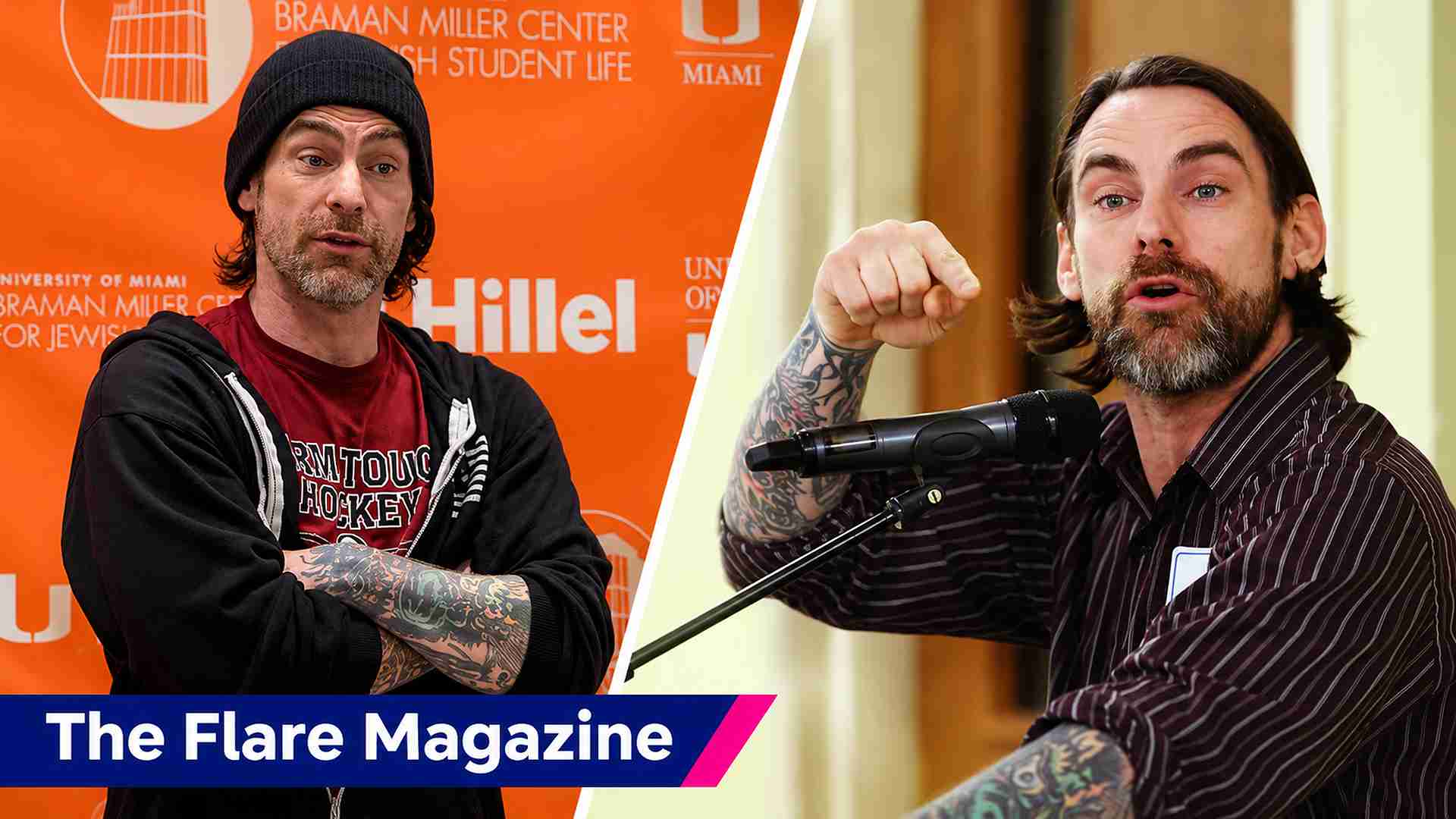
Frank Meeink is an American author, activist, and former neo-Nazi skinhead leader who now speaks out against hate. He is also the husband of former Smallville actress Allison Mack, and his story is often linked to the film American History X.
His work began long before his marriage drew attention in 2025. After prison and a difficult break from racism, he helped young people build friendships, worked with former extremists, and found a new purpose in recovery support.
Here, we will look at his childhood, the violence that led him to prison, the people who changed his views, his work against hate, his Jewish faith, his book, his marriage, and his life in 2026.
A Childhood Shaped by Fear in Philadelphia
Frank Meeink grew up in South Philadelphia, where home life was often unstable. He has described financial hardship, substance abuse within the family, and violence from his stepfather.
His parents separated when he was young, and he later moved to live with his father. At a new school, he struggled to find his place and often felt alone.
During visits to an older cousin in Lancaster County, Pennsylvania, he met teenagers involved in neo-Nazi skinhead groups. They listened to him, asked about his life, and made him feel important.
That attention filled a gap he had felt at home. The group offered him a place to belong, but its bond was built on hate. His childhood helps explain why he was drawn in, not why the harm he later caused should be excused.
How Frank Meeink Became a Neo-Nazi Recruiter
Meeink joined the skinhead movement in his early teens, then began to recruit others. He adopted racist beliefs and took part in violent attacks against people his group saw as enemies.
By the early 1990s, he was active in a group called Strike Force. He also appeared on The Reich, a public-access television program that pushed neo-Nazi ideas.
He has said that he once enjoyed the fear his group caused. Violence gave him a false sense of control, while group loyalty made it easier to ignore the pain of victims.
This was not only hateful speech. The attacks were real, and his role in one crime ended with a prison sentence.
The Crime, Prison, and the First Change in His Thinking
In 1992, at age 17, Frank Meeink took part in the kidnapping and assault of an anti-racist activist in Illinois. He was convicted, received a three-year prison sentence, and served about a year.
In prison, he played football with Black inmates. For the first time in years, he had close and friendly contact with people he had been taught to fear.
They became teammates, and their shared time began to challenge his beliefs. He saw that their lives and character did not fit the racist stories he had accepted.
The change was not sudden. He left prison with questions about his ideology, but his journey away from white supremacy continued after he returned home.
He did not change because someone gave him one perfect argument. His ideas began to fall apart as he got to know real people.
A Jewish Employer Helped Him Leave Hate Behind
After prison, Meeink struggled to find work because of his record and visible Nazi tattoos. In 1994, he took a job moving antiques for a Jewish businessman named Keith Brookstein in New Jersey.
Keith offered work, paid him fairly, and treated him with respect. That kindness clashed with every antisemitic stereotype Meeink had learned.
The two spent time working and talking together. For Frank Meeink, those daily conversations were as important as the lessons he had begun to learn in prison.
He later described the experience in an interview with the United States Holocaust Memorial Museum. He recalled how working for a man he had been taught to hate made him face the truth about his own beliefs.
By the mid-1990s, he had broken with the movement. He later had his swastika tattoo removed, leaving behind one of the most visible signs of his old identity.
Building Communities Through Hockey
Meeink had loved hockey since childhood. After leaving the skinhead movement, he saw how the sport could help children meet others outside their usual circles.
In 1996, Frank Meeink helped launch Harmony Through Hockey. The Philadelphia Department of Recreation and the Philadelphia Flyers supported the program.
Children from different races and backgrounds played on the same teams. They learned to work together and build trust through a game they could all enjoy.
The program ran until 2000. Its purpose was simple: shared time and teamwork can help people move past fear before it turns into prejudice.
There was a personal reason for that approach. Playing sports with men from other backgrounds had helped Meeink rethink his own views in prison.
From Former Extremist to Anti-Hate Advocate
Life After Hate and Direct Intervention
In 2011, Meeink joined an international summit on violent extremism in Ireland. He helped found Life After Hate, a nonprofit that helps people leave violent extremist groups.
Frank Meeink worked with the group as a co-founder and interventionist from 2011 to 2018. He met people still caught in hate movements and spoke with them about building lives outside those groups.
He also visited schools, colleges, and civic events. His talks covered recruitment, racism, and the need for a sense of belonging that does not depend on hurting others.
This work was different from his hockey program, but the core idea remained. A relationship can open the door to change when an angry public argument cannot.
His Testimony Before Congress
In September 2020, Frank Meeink testified before a U.S. House subcommittee about white supremacy and law enforcement. He described extremist meetings he had attended as a young man.
He said some leaders urged followers to hide their tattoos and enter police departments. He warned that screening and oversight were important to keep hate groups from gaining power.
His remarks drew on his own past. They were part of his broader work on civil rights and the risks posed by violent extremist networks.
Was American History X Based on His Life?
Meeink is often associated with American History X, the 1998 film starring Edward Norton as Derek Vinyard. The movie follows a violent neo-Nazi who starts to question his beliefs while in prison.
There are clear similarities to parts of Frank Meeink’s life. Yet the movie has a different setting, family story, and many events that do not match his experiences.
Some news articles have called him an inspiration for the film. That is not the same as saying it is a true account of his life.
Meeink himself has challenged the idea of a direct link. In a May 2026 interview on The Hidden Third, he again said he was not the film’s inspiration.
It makes more sense to see the two stories as sharing themes of racism, prison, and change. American History X is a fictional drama, while his own life has a separate history.
From Antisemitism to Jewish Faith
The story of Frank Meeink also includes an unexpected spiritual change. Years after leaving white supremacy, he began exploring Jewish belief, history, and family ties.
A rabbi in Des Moines encouraged him to learn about his ancestry in 2014. Family research and DNA testing later supported his discovery of Jewish roots.
By then, he was already building ties with Jewish friends and mentors. He began studying the Torah, observing Shabbat, and making faith part of his daily routine.
His journey to Judaism drew fresh public interest in 2024. On November 3, 2026, he spoke about it at Tifereth Israel Synagogue in San Diego.
The talk focused on how education, relationships, and faith had helped shape his new life. His commitment to Jewish practice is now part of how he describes himself.
Addiction, Personal Loss, and Recovery
Leaving hate did not mean that every part of Meeink’s life became easy. He has described a long struggle with alcohol, drugs, and periods of relapse.
He also lost his son Josh and his mother, and an earlier marriage came to an end. Those painful events formed part of the crisis that led him to seek treatment in Los Angeles in 2019.
A Jewish recovery mentor became an important source of support. Frank Meeink has spoken about the daily habits, honest talks, and community ties that helped him stay on a healthier path.
Today, he brings that experience into his work with others. He understands that recovery often takes time and that people need support long after their first step.
His journey away from extremism and his work in addiction recovery are not the same thing. But both show how much steady human contact can matter.
Frank Meeink and Allison Mack: How They Met
Frank Meeink married Allison Mack in June 2025 in a small ceremony in the Los Angeles area. Mack is known for playing Chloe Sullivan on Smallville.
She also served prison time after pleading guilty to crimes linked to the NXIVM organization. The couple met in February 2024, when both were walking dogs at a Los Angeles park.
Meeink commented on Mack’s dog, and the conversation grew from there. They later saw each other at a Thai restaurant where he was working.
They found common ground in their experiences with prison and their interest in justice reform. Both have spoken about being open with each other about their pasts.
The marriage became public in June 2025. Later that year, Allison After NXIVM shared more of their relationship, and he discussed their first meeting again in a May 2026 interview.
What Frank Meeink Does in 2026
In recent years, Meeink’s work has spread beyond school talks and anti-racism events. From 2024 to 2026, he served with SHARE in Los Angeles, helping people facing mental health problems, addiction, and homelessness.
During the Los Angeles wildfires in January 2025, he helped people in recovery stay in touch with support groups. He also helped connect people with help when their normal routines were disrupted.
His official biography describes current work in peer support and drug and alcohol counseling. It also says he is working toward becoming a Jewish chaplain.
At his November 2026 talk in San Diego, he discussed studying human services and addiction care. He hopes to use that education to support people in recovery.
Frank Meeink continues to speak about racism and antisemitism. At the same time, much of his daily work now focuses on helping people find care, stability, and a way forward.
His Book and Documentary Work
Frank Meeink wrote Autobiography of a Recovering Skinhead with scholar Jody M. Roy. The memoir was published in 2010, and an expanded second edition followed in 2017.
It covers his difficult childhood, role in extremist violence, prison years, addiction, and the effort to build a different life. The later edition adds chapters and resources about recovery and racism.
He has also appeared in radio interviews and film projects, including the 2019 documentary series Why We Hate. His accounts help readers see why some young people are drawn into extremist groups and what leaving can require.
Questions About Frank Meeink
How Old Is Frank Meeink in 2026?
He was 51 years old in 2026, as confirmed by an interview published in June that year.
Why Did He Go to Prison?
He was convicted for taking part in a kidnapping and violent assault in 1992. He received a three-year sentence and served roughly one year.
Is He Still With Life After Hate?
Meeink helped found Life After Hate and worked with it from 2011 to 2018. He later moved into other speaking, counseling, and community support roles.
What Is His Best-Known Book?
His memoir is Autobiography of a Recovering Skinhead, written with Jody M. Roy. It recounts his extremist past, the people who changed his thinking, and his struggle to rebuild.
Why His Story Still Matters
Frank Meeink caused real harm as a young extremist. His work today does not erase that harm or the pain felt by those he hurt.
What his story can show is the long effort it takes to face a violent past and choose a different life. People helped him challenge his ideas, and he has tried to offer that same chance to others.
His public work now spans anti-hate education, recovery care, and Jewish community life. It is a story about change, but also about the duty to keep making better choices.
You may also read: Melia McEnery and her work with Turn Up For Recovery, another account of community support for people facing addiction.