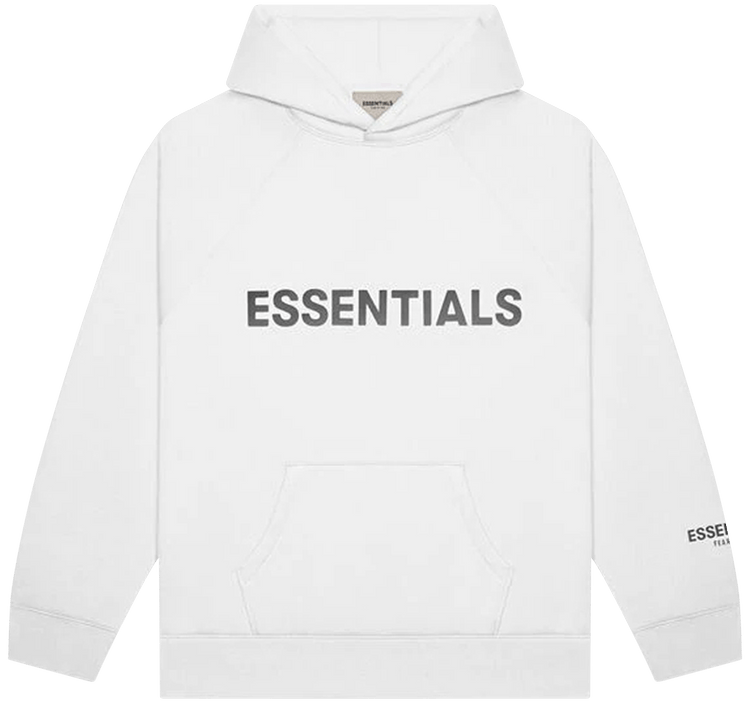
Sixty-four hoodies on one page, and sorting them by price tells you almost nothing. The cheapest sits at £110. The dearest is £120. That’s the entire spread — a tenner across a whole category — so once you’ve clocked it, choosing an Essentials Hoodie stops being a budget question and turns into a question about colour, weight and cut.
Seven prices, and they come in tens
Here is where the sixty-four actually land. The pattern is odd in a way that’s worth knowing before you start lining hoodies up against each other.
| Price | Hoodies at that price |
| £110 | 10 |
| £111 | 10 |
| £114 | 4 |
| £116 | 10 |
| £118 | 10 |
| £119 | 10 |
| £120 | 10 |
Six of the seven tiers hold exactly ten hoodies. One holds four. That isn’t a fabric ladder — nobody sits down and decides that four cloths are worth £114 while ten others are worth £116. It reads far more like stock going up in batches, with each batch priced in one go, and the £1 and £2 gaps between tiers are too small to mean anything on the rail.
The four at £114
That odd little tier is the one I’d look at first, purely because it’s strange. Four hoodies share £114 while every other price point carries ten, and the ones sitting there are about as plain as this catalogue gets — a black, a white, and the 1977 piece among them. Flat colours, no print doing the talking.
There’s no discount story in it. £114 is £4 under the top of the band and £4 over the bottom, so it sits almost exactly in the middle. But if you want a hoodie that disappears into the rest of your wardrobe rather than announcing itself, that tier is a short list someone else has already written for you.
Cut isn’t doing the work
A zip-up lives at £110. Another zip-up lives at £120. The cropped hoodie sits at the bottom of the band, the drop-shoulder and the oversized pullover are up at £119, and a plain pullover is at £120. The shapes are scattered straight across the seven tiers instead of climbing with them.
So if you walked in expecting a zip to cost more than a pullover — plenty of shops do charge you for the hardware — that assumption doesn’t survive this page. Neither does the idea that an oversized body costs extra for the extra cloth.
Then what is moving it?
Not much that shows from outside, honestly. A handful of the names hint at what you’re buying: a brushed fleece, a cotton fleece, a nylon-faced piece, a long-sleeve build. Those four land at £110, £119, £119 and £110, which refuses to line up in any direction. And the crossed-out figures printed beside the live prices are no help at all — they swing between £270 and £390 without tracking the real number, so the figure to read is the one you’d pay at the till.
Which leaves you oddly free, once you turn it round — when the money barely separates one hoodie from the next, there’s nothing left to rank and you just end up choosing the one you like.
What to compare instead
So the comparing has to happen somewhere other than the price tag, and weight is where I’d start, because that’s the part you feel waiting for a bus rather than read off a label. After that it gets personal fairly quickly:
- How pale the colour is. Cream, light oatmeal and light grey will show a wet pavement, a coffee lid and a rucksack strap in a way that burgundy and jet black won’t bother to.
- Zip or no zip, which sounds trivial until you’re overheating on a packed train with no way of opening the thing.
- Whether the shoulder seam has already handed you a size of extra room — drop-shoulder and oversized bodies both do, and nobody tells you that until it arrives.
- Fleece, brushed or thin. February decides this one for you.
Where hoodies sit against the rest of the shop
For context, and only that: shirts on this site run £95 to £99, sweatshirts £105 to £109, and a full tracksuit jumps to £140 to £160. The hoodie band sits in the upper middle of the catalogue — a clear step above a shirt, well under a tracksuit. Every one of those categories is squeezed into a few pounds as well, so the tight band isn’t a hoodie quirk. It’s how the whole shop prices.
Is the £120 hoodie better than the £110 one?
Nothing on the page proves it is. Ten pounds on a £110 garment is under a tenth of what you’re spending anyway, and what it actually buys is a different colour or a different fastening, not a better build — which is worth saying out loud, because it changes the whole way you shop the category.
What you want is the colour you’ll grab at seven in the morning when it’s grey out and you’re already behind, in whatever weight suits how you layer, and the price can land wherever it likes. It was never going to move far.
Frequently Asked Questions
What’s the full hoodie price range?
£110 at the bottom, £120 at the top, across sixty-four pieces. Seven price points sit inside that band and six of them carry ten hoodies each.
Does a zip-up cost more than a pullover?
Not here. Zip styles turn up at £110 and at £120, and pullovers do the same, so the fastening isn’t what you’re being charged for.
Are hoodies the dearest thing in the shop?
No. Tracksuits run higher at £140 to £160, and the bags and accessories reach £210 at the top of their range. Hoodies sit above shirts and sweatshirts and below those.
If the decision has been sitting in a browser tab while you work out which hoodie is worth the extra money, let it go — on a ten-pound spread there isn’t one. Sort by colour, settle on how heavy you want the fleece, and buy the hoodie you’ll still be pulling on through a damp Manchester October.