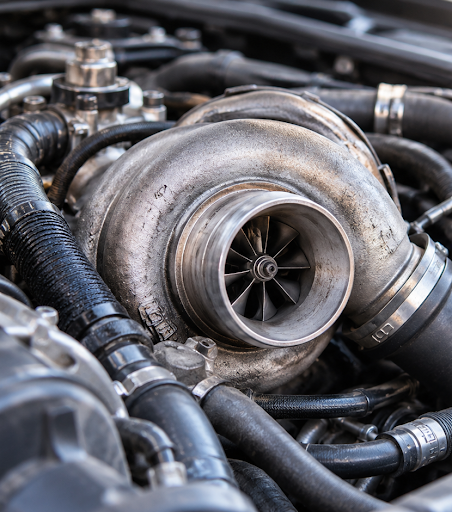
A turbocharger is one of those parts you never think about until it starts to go wrong. The car feels flat when you accelerate. A thin whine builds under the bonnet. Smoke trails from the exhaust, or a warning light flicks on and the engine suddenly seems to give up on hills.
Any one of these can be a sign that the turbo is failing, and ignoring them is how a manageable repair turns into engine damage.
The good news is that a turbo rarely fails without warning, and turbo failure symptoms usually show up weeks or months before it breaks. Most of the time there are signs for weeks or months beforehand, and spotting them early gives you the chance to deal with the cause as well as the symptom.
Regular car servicing is one of the best defences, because clean oil and a healthy engine are what a turbo depends on most.
This guide covers the main turbo failure symptoms, what causes them, how to tell a turbo problem from other faults, whether it is safe to keep driving, and how to help a turbo last.
What Does a Turbo Do, and Why Does It Fail?
A turbocharger uses the hot exhaust gas leaving the engine to spin a turbine. That turbine drives a compressor which forces extra air into the engine, so it can burn more fuel and produce more power from a smaller size. It is why a modern one litre petrol engine or a two litre diesel can feel so lively. Most diesel cars have a turbo, and a growing number of petrol cars do too.
The catch is the conditions it works in. The turbine can spin at extremely high speed, and it sits right next to the exhaust, so it runs very hot. The shaft is supported on bearings that float on a thin film of engine oil, and that oil also carries heat away. A turbo is therefore completely dependent on a steady supply of clean oil at the right pressure. When that supply is interrupted, dirty or too hot, the bearings wear, the seals leak and the turbo starts to fail.
Turbo Failure Symptoms: The Main Warning Signs
No single symptom proves the turbo is at fault, but several together make a strong case. These are the signs worth taking seriously.
1. Loss of power
This is the most common sign. The car feels sluggish, struggles on hills or when overtaking, and no longer pulls the way it used to. Because a turbo adds power on demand, a failing one leaves the engine running as if it had no boost at all. Power loss is most noticeable when you accelerate or hold speed on a motorway.
2. A whining, whistling or siren noise
A faint whoosh from a turbo is normal. A loud, rising whine, often compared to a siren or a dentist’s drill, is not. It tends to get louder as you accelerate and can point to worn bearings or a damaged compressor wheel. A grinding or rattling noise is a particularly bad sign, because it can mean parts of the turbo are breaking up.
3. Blue or grey exhaust smoke
Blue or grey smoke usually means oil is being burned. If the turbo’s seals are worn, oil can pass into the exhaust or the intake and burn with the fuel. A garage will want to rule out other causes, as worn valve seals and a head gasket can give similar smoke, but a turbo is a prime suspect when smoke appears alongside power loss or noise.
4. Black smoke
Black smoke points to too much fuel and not enough air. A turbo that is not delivering its normal boost can cause exactly that, because the engine is no longer getting the air it expects. It can also come from other faults, such as a dirty air filter or a problem with the fuel system.
5. Rising oil consumption
If you find yourself topping up engine oil more often, and there is no visible leak on the drive, oil may be going through the turbo and being burned. Check the dipstick regularly if you suspect it, and do not let the level run low, because low oil also damages the turbo.
6. Warning lights and limp mode
Modern cars monitor boost pressure. If it is lower or higher than expected, the engine management light can come on and the car may drop into limp mode, which limits power to protect the engine. A diagnostic scan may reveal fault codes such as underboost.
7. Oil leaks around the turbo
Oil around the turbo, on the pipes or in the intercooler hoses is a clear warning. A burning oil smell from the engine bay is another. Small leaks can come from the seals, the oil feed and return pipes or the turbo housing.
8. Worse fuel economy and slow response
When a turbo struggles to build boost, the engine works harder to do the same job, so fuel economy often drops. You may also notice a delay before the power arrives, sometimes called lag, or a surging feeling as the boost comes and goes.
| What you notice | Possible turbo link | How urgent |
| Loss of power | Boost not building | Book a check soon |
| Whine, siren or grinding noise | Worn bearings or damaged wheels | Stop and get advice quickly |
| Blue or grey smoke | Oil seal leaking | Urgent |
| Black smoke | Too little boost or air | Check soon |
| Rising oil use | Oil passing the seals | Check soon |
| Warning light or limp mode | Boost fault detected | Book a scan |
| Oil around turbo or pipes | Leaking seal or pipe | Urgent |
| Poorer economy, slow response | Weak or lazy boost | Check soon |
What Causes a Turbo to Fail?
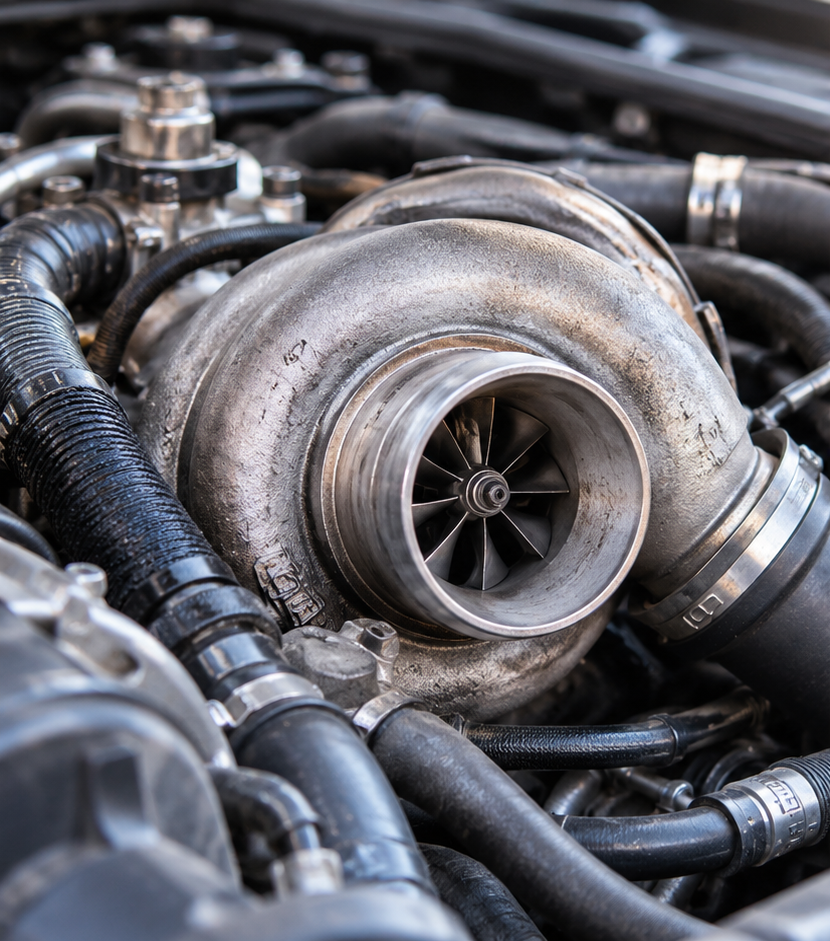
Turbos are built to last, and when one fails early the cause is almost always something outside the turbo itself. Fixing the turbo without finding that cause usually means the new one fails too.
Oil starvation
Low oil level, a blocked oil feed pipe or a failing oil pump can leave the bearings without lubrication. Even a short time without oil at those speeds can destroy them. Keeping the oil topped up and the engine serviced on time prevents most of it.
Dirty or poor quality oil
Old oil carries sludge, dirt and tiny metal particles that wear the bearings and shaft. The wrong grade of oil flows differently and may not protect the turbo as designed. This is why oil changes at the right interval, with the specification your car calls for, matter so much.
Heat
The turbo sits in the hottest part of the engine. Hard driving followed by switching off straight away can leave oil in the turbo to bake, forming deposits. Over time those deposits restrict oil flow and wear the parts. Overheating from a cooling system fault adds to the problem.
Foreign objects
Debris entering the intake, such as a loose piece of hose, a damaged air filter or something left in the airbox, can strike the compressor wheel at high speed. Fragments from the exhaust side can do similar damage to the turbine.
Boost leaks and control faults
A split intercooler hose, a loose clamp or a stuck actuator can cause the turbo to over or under boost. Pushing a turbo to work harder to compensate for a leak puts it under stress it was not designed for.
Wear and age
Even a well maintained turbo wears eventually. Many last well over 100,000 miles, but the figure varies a lot with the engine, the driving and the maintenance history.
| Cause | How it damages the turbo | How to reduce the risk |
| Oil starvation | Bearings run dry and wear fast | Check the oil level and fix leaks early |
| Dirty oil | Particles grind bearings and shaft | Change oil on time with the right grade |
| Heat | Oil bakes into deposits | Avoid shutting down straight after a hard run |
| Foreign objects | Wheels are chipped or broken | Keep the air filter and intake in good order |
| Boost leaks | Turbo works harder to compensate | Fix split hoses and loose clamps |
| Age and wear | Seals and bearings tire | Watch for the early signs |
Is It the Turbo or Something Else?
Many turbo symptoms overlap with other faults. Replacing a turbo that was never the problem is an expensive mistake, so it pays to rule the rest out first.
| Symptom | Could be the turbo | Could also be |
| Loss of power | Weak or failed boost | Blocked diesel particulate filter, faulty EGR valve, dirty air flow sensor, fuel supply problems |
| Black smoke | Insufficient boost | Dirty air filter, faulty injectors, air flow problems |
| Blue or grey smoke | Leaking turbo seals | Worn valve seals, piston ring wear, head gasket problems |
| Limp mode | Boost fault detected | Sensor faults, split hoses, actuator problems |
| Whistling noise | Worn turbo | A leak in a boost pipe or intercooler hose |
A split hose or loose clamp is a common reason for a car to lose power and whistle, and it is a far simpler fix than a turbo. That is why a proper diagnosis comes before any decision to replace parts. Booking engine diagnostics in Fleet or at a garage near you means the fault codes are read and the boost pipes are tested before anyone suggests a new turbo.
Is It Safe to Drive With a Failing Turbo?
Technically the car may still run, but it is not a good idea to carry on for long. A weak turbo means less power for overtaking and joining fast roads, which is a safety issue in itself. More seriously, if the turbo is breaking up, fragments of the compressor wheel can pass into the engine and cause serious damage, and a leaking seal can put oil into the intake and exhaust.
In rare cases, a diesel engine that is drawing in oil through a failed turbo can start to rev on its own, because it burns the oil as extra fuel. It is uncommon, but it is dangerous and needs urgent professional help.
What to Do If You Think Your Turbo Is Failing
- Ease off. Drive gently, avoid hard acceleration and keep the revs moderate.
- Check the oil level. When the engine is cool and the car is on level ground, check the dipstick and top up if it is low, using the grade your handbook specifies.
- Look for obvious clues. Oil around the turbo, a split hose or a loose clamp on a pipe are all worth noting.
- Do not keep driving if it gets worse. Heavy smoke, a loud grinding noise, an oil pressure warning or a sudden loss of power are all reasons to pull over safely and call for recovery.
- Get it diagnosed. A proper inspection finds out whether it is the turbo or something cheaper and simpler.
Drivers around Hook and Yateley who rely on motorway journeys should be particularly cautious, because a car that cannot build speed safely is a hazard on fast roads.
A local independent garage such as TJ Services Fleet can check a suspected turbo fault before it turns into a bigger repair.
How Is a Failing Turbo Diagnosed?
A garage does not simply guess. A sensible diagnosis works through the possibilities in order, so that the cheap, simple causes are ruled out before the expensive ones.
- Fault codes. A diagnostic scan reads any stored codes, such as underboost or overboost, and shows what the engine management system has noticed.
- Oil check. The level and condition of the oil are checked, since low or dirty oil is a common cause.
- Visual inspection. The turbo, its pipes and the intercooler hoses are checked for leaks, splits, loose clamps and signs of oil.
- Boost leak check. The intake system is tested for air escaping between the turbo and the engine.
- Actuator and control check. The parts that control boost are tested to see whether they move freely and respond correctly.
- Turbo inspection. The turbo may be examined for play in the shaft, damage to the compressor wheel or oil in the pipework.
- Related systems. Air filters, particulate filters and EGR valves are checked, since faults there can mimic turbo problems.
It is worth asking the garage to explain what they found and how they know, so you understand whether the turbo itself is at fault or something around it.
Can a Turbo Be Repaired or Does It Need Replacing?
It depends on the fault. If the cause is a split hose, a loose clamp, a stuck actuator or a blocked pipe, fixing that may restore normal boost without touching the turbo itself. If the turbo has worn bearings, damaged wheels or failed seals, it generally needs repair or replacement.
Options usually include a new turbo, a reconditioned one, or having the existing unit rebuilt, and each has different costs and warranties. Whichever route is chosen, three things matter:
- Find the root cause. If the oil supply was blocked or the oil was contaminated, a new turbo will fail again.
- Replace related parts. Oil feed pipes and the oil itself are often renewed at the same time, because debris from the old turbo can remain in the system.
- Ask about the warranty. Make sure you know what is covered and for how long.
How to Make a Turbo Last Longer
You cannot make a turbo last forever, but good habits make a big difference. Most of them are about protecting the oil supply and keeping the engine healthy.
| Habit | Why it helps |
| Service the car on schedule | Fresh oil and clean filters protect the bearings |
| Use the oil grade your handbook specifies | The turbo is designed around a particular oil |
| Check the oil level between services | Low oil is one of the quickest ways to damage a turbo |
| Let the engine warm up gently | Cold oil flows slowly and takes time to reach the turbo |
| Avoid hard revving when the engine is cold | The turbo needs oil pressure before it works hard |
| Let the car settle after a long hard drive | Helps heat dissipate before the engine is switched off |
| Keep the air filter in good order | Stops debris reaching the compressor wheel |
| Fix boost leaks and warning lights promptly | Stops the turbo working harder than it should |
Some manufacturers have different advice on cooling down after hard driving, particularly for newer cars with water cooled turbos, so check your handbook. Drivers near Odiham and Crondall who tow, carry heavy loads or do a lot of fast driving put more demand on their turbo and should be extra careful about oil changes.
Do Turbo Problems Differ on Diesel and Petrol Cars?
The warning signs are much the same, but each type has its own habits and extra causes.
Diesel turbos have worked in everyday cars for decades, so many drivers know the pattern well: loss of power, smoke and limp mode. Diesels also have extra systems that sit close to the turbo, including the diesel particulate filter and the EGR valve, and faults in those can look like turbo trouble. A blocked particulate filter, for instance, can choke the exhaust and make the car feel as if the turbo has given up.
Petrol turbos are now common in small, efficient engines, and they run hotter than diesel turbos because petrol exhaust gas is hotter. That makes oil quality and cooling especially important. Because many petrol turbo engines are also tuned to extract a lot of power from a small size, they have less margin for neglected servicing.
In both cases the advice is the same: do not assume the turbo is the culprit until the other causes are ruled out.
Turbo Myths Worth Dropping
| Myth | Reality |
| “A turbo always fails suddenly” | Most give warning signs first, such as noise, smoke and power loss |
| “Loss of power always means a bad turbo” | Boost leaks, filters and sensors can cause the same symptom |
| “A new turbo will fix the problem for good” | If the cause was oil related and is not fixed, the new one can fail too |
| “Smoke is normal for a turbocharged car” | Persistent blue, grey or black smoke is a warning sign |
| “Turbos do not need special care” | Clean oil, the right grade and gentle warm ups all extend their life |
| “Topping up oil can wait until the next service” | Low oil can destroy turbo bearings quickly |
Conclusion
A turbo rarely fails without warning. Loss of power, a rising whine, blue or black smoke, rising oil use and warning lights are the signs to act on. Many of these can have other causes, so get a proper diagnosis before any parts are replaced.
Most turbo failures come back to the oil, so keep up with servicing and check the oil level between services.
If you notice the signs, ease off and get the car checked before you drive further than you need to. Drivers in Fleet and Church Crookham can call TJ Services Fleet on 01252 622200 or get directions to the garage at 31 Sandy Lane, Church Crookham.
Frequently Asked Questions
What are the first signs of a failing turbo?
Usually a loss of power and a new noise, such as a whine or whistle that gets louder as you accelerate. Smoke from the exhaust and a rising need to top up the oil often follow.
Can I drive with a failing turbo?
The car may still run, but it is not advisable. Reduced power can be unsafe, and a breaking turbo can damage the engine. If there is heavy smoke, loud grinding or a warning light, stop safely and get advice.
What causes a turbo to fail?
Most failures come from oil problems, such as low oil, dirty oil or a blocked oil feed. Heat, foreign objects, boost leaks and ordinary wear are other causes.
What colour smoke means a turbo is failing?
Blue or grey smoke often means oil is being burned, which can point to worn turbo seals. Black smoke can mean the engine is getting too little air or too much fuel. Other faults can cause either, so the car needs diagnosing.
How do I know if it is the turbo or something else?
Many symptoms overlap with blocked particulate filters, faulty EGR valves, boost leaks and sensor faults. A diagnostic scan and a proper inspection are the reliable way to tell them apart.
How long should a turbo last?
It varies. Many last well over 100,000 miles with good maintenance, while poor oil changes, low oil or heavy use can shorten that considerably.