
An organization may have hundreds of automated workflows and still struggle with rising operating costs, inconsistent service delivery and fragmented information. The problem is not necessarily a lack of technology but the absence of a coordinated strategy that connects technology investments with business priorities.
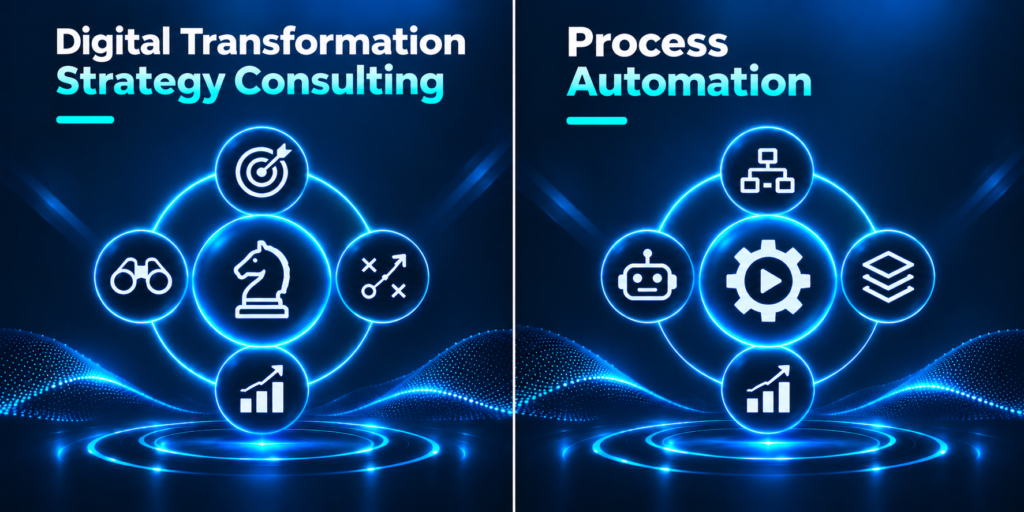
Digital transformation strategy consulting helps organizations establish this direction by evaluating existing capabilities, defining future-state requirements and developing investment roadmaps. Process automation supports the execution of these strategies by reducing manual intervention and improving operational consistency.
When these disciplines work together, organizations can move beyond isolated efficiency initiatives toward a coordinated transformation program that supports profitability, scalability and long-term competitiveness.
Why disconnected automation initiatives create new challenges
Individual departments often introduce automation to address immediate operational problems. Finance may automate invoice processing, HR may introduce employee self-service, and procurement may digitize purchasing approvals.
Although these initiatives can deliver local benefits, independently developed solutions may create integration challenges, duplicated technology expenditure and inconsistent governance.
Digital transformation strategy consulting helps organizations evaluate these investments from an enterprise perspective. It establishes common technology standards, identifies shared requirements and determines where coordinated implementation could generate greater returns.
Without this direction, process automation can become another source of organizational complexity rather than a mechanism for reducing it.
What is digital transformation strategy consulting?
Digital transformation strategy consulting is a professional service that helps organizations define how digital technologies, redesigned processes and organizational capabilities should support their business objectives.
It extends beyond technology selection to address investment priorities, enterprise architecture, operating models and workforce requirements.
A consulting engagement typically establishes a future-state vision, evaluates existing capabilities and develops a roadmap that connects transformation initiatives with expected business outcomes.
The objective is to ensure digital investments address significant performance challenges while establishing capabilities that support future growth.
How does process automation support digital strategy?
Process automation uses technology to execute repetitive activities, coordinate workflows and reduce manual intervention within business operations.
Its applications range from straightforward transaction processing to intelligent workflows involving multiple enterprise systems.
Within a broader digital strategy, automation helps organizations implement standardized processes, improve resource utilization and establish consistent operational controls.
However, its effectiveness depends on whether the underlying workflows are appropriately designed and aligned with business requirements.
Four strategic decisions that shape automation investments
1. Determine which processes deserve investment
Organizations should evaluate operational costs, transaction volumes, service requirements and recurring performance problems.
Digital transformation strategy consulting can help leaders distinguish high-value opportunities from activities where automation would generate limited benefits.
2. Decide which capabilities should be shared
Different business functions may require similar capabilities, such as document processing, workflow management and enterprise knowledge retrieval.
Establishing reusable infrastructure can reduce development costs and simplify future implementation.
3. Balance standardization with business flexibility
Process automation should support consistent execution without restricting legitimate operational differences. Organizations must determine which procedures can be standardized and which require flexibility.
4. Establish the future workforce model
Automation changes the distribution of work between employees and technology. Workforce planning should address future responsibilities, specialist capabilities and opportunities to redirect available capacity toward higher-value activities.
Developing a coordinated transformation portfolio
A transformation portfolio should balance foundational investments with initiatives that generate immediate operational benefits.
Digital transformation strategy consulting helps organizations sequence these investments according to business value, implementation dependencies and available resources.
This portfolio-based approach prevents individual technology projects from competing for investment without consideration of broader enterprise requirements.
A practical example: Transforming the procure-to-pay process
Consider an organization experiencing high purchasing administration costs, delayed supplier payments and frequent invoice discrepancies.
Introducing automated invoice processing may reduce administrative effort, but it may not address inconsistent purchasing policies or inaccurate supplier records.
A coordinated transformation could involve standardizing purchasing procedures, improving supplier data, integrating enterprise applications and redesigning exception management responsibilities.
Process automation could then support purchase order creation, invoice matching and approved payment workflows.
Digital transformation strategy consulting would connect these changes through a common implementation roadmap, ensuring that improvements across procurement and finance reinforce one another.
The resulting benefits could extend beyond productivity to include stronger supplier relationships and improved working capital management.
How generative AI expands automation opportunities
Conventional automation performs effectively when activities follow predictable rules. Generative AI extends these capabilities by supporting tasks involving language, contextual interpretation and unstructured information.
For example, an intelligent application can summarize supplier correspondence, investigate service requests or retrieve relevant enterprise policies.
AI agents can further support approved workflows by coordinating activities across multiple applications.
These developments expand the potential of process automation, particularly within knowledge-intensive business services.
Digital transformation strategy consulting can help organizations evaluate where intelligent capabilities justify additional investment and where conventional technologies remain sufficient.
Consequential decisions and automated actions should remain subject to appropriate validation and authorization.
Preventing automation from becoming a long-term cost burden
Automation solutions require ongoing maintenance, integration management and performance monitoring. As organizations introduce additional applications, these responsibilities can increase technology expenditure.
A sustainable process automation strategy should consider the complete life-cycle cost of each solution rather than initial implementation expenses alone.
Reusable architecture, standardized development practices and clear ownership can reduce maintenance complexity.
Organizations should also periodically evaluate whether existing automated workflows remain necessary as business requirements evolve.
Removing obsolete applications and consolidating duplicated capabilities can improve the long-term economics of transformation.
Measuring transformation through financial and operational outcomes
Successful digital transformation strategy consulting should establish clear performance expectations before implementation begins.
Relevant indicators include:
Operating cost reductions and avoided future expenditure.
Improvements in end-to-end process cycle times.
Workforce productivity and available capacity.
Service quality and stakeholder satisfaction.
Technology maintenance and integration costs.
Realized return on transformation investments.
Process automation should be evaluated through its contribution to these outcomes rather than the number of workflows automated.
Organizations must also distinguish between estimated time savings and actual financial benefits. Released capacity creates value when it supports additional productive work, avoids expenditure or enables sustainable cost reductions.
Establishing governance for continuous transformation
Digital capabilities and business requirements will continue to evolve after initial implementation. Organizations therefore need governance arrangements that support ongoing investment evaluation and operational improvement.
Digital transformation strategy consulting can establish responsibilities for technology management, process ownership and value realization.
Accountable process owners should monitor workflow performance, investigate recurring exceptions and identify emerging improvement opportunities.
This allows process automation to evolve alongside organizational priorities rather than remain tied to outdated business requirements.
Conclusion
Digital transformation strategy consulting provides the strategic direction required to connect technology investments with enterprise performance priorities. Process automation supports this direction by improving workflow efficiency, operational consistency and resource utilization.
Their combined value depends on disciplined investment decisions, reusable technology capabilities and clear organizational accountability.
Businesses that approach automation as part of a coordinated transformation portfolio can reduce operational complexity, improve financial performance and establish the flexibility required to respond to changing market conditions.
