
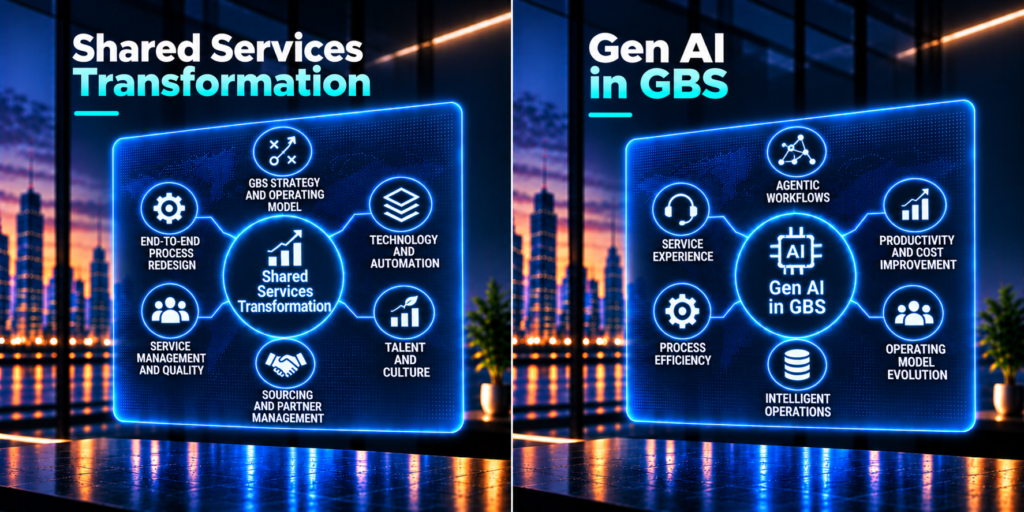
The traditional economics of centralized business services depend heavily on economies of scale, standardized processes and workforce efficiency. However, as transaction volumes increase and stakeholder requirements become more sophisticated, these advantages may no longer be sufficient to sustain performance improvements.
Shared services transformation offers an opportunity to reconsider the relationship between operating costs, service capacity and enterprise value. Gen AI in GBS (global business services) expands this opportunity by enabling organizations to redesign knowledge-intensive activities that were previously difficult to automate.
The emerging challenge is determining how intelligent capabilities can change the economics of service delivery without compromising operational reliability.
Why traditional service delivery economics are changing
Centralized service organizations have historically reduced costs by consolidating activities, eliminating duplication and accessing lower-cost talent markets. While these strategies remain relevant, they have practical limitations.
Adding employees to accommodate growing workloads increases expenditure. Similarly, conventional automation may struggle with unstructured information and complex exceptions.
Gen AI in GBS introduces another possibility: reducing the effort required to interpret information, investigate problems and coordinate activities.
Shared services transformation can incorporate these capabilities into a redesigned delivery model where service capacity becomes less dependent on workforce expansion.
What is shared services transformation in an AI-enabled enterprise?
Shared services transformation is the redesign of centralized business service operations to improve productivity, service effectiveness, scalability and enterprise value.
It involves changes to process ownership, organizational structures, workforce responsibilities, technology infrastructure and performance management.
In an AI-enabled environment, transformation also examines how responsibilities should be distributed among employees, conventional automation and intelligent agents.
For example, a finance service center could redesign its invoice exception management process so that intelligent applications prepare investigations while specialists resolve complex commercial discrepancies.
How does Gen AI in GBS create business value?
Gen AI in GBS refers to the application of generative artificial intelligence across centralized, multifunctional business services, including finance, procurement, human resources and IT.
Generative capabilities can interpret documents, summarize information, retrieve organizational knowledge and support contextual interactions.
Their value becomes particularly significant when deployed across standardized processes that serve multiple business units.
A common intelligent knowledge platform, for instance, could support several service teams while maintaining function-specific access permissions and governance requirements.
This creates opportunities to distribute technology costs across a broader service portfolio.
Three areas where generative AI changes service delivery economics
1. Reducing the cost of managing exceptions
Exceptions frequently require employees to retrieve information, investigate discrepancies and communicate with stakeholders.
Gen AI in GBS can reduce investigative effort by consolidating relevant information and preparing contextual summaries. Specialists can then focus on resolving issues rather than assembling supporting evidence.
The resulting productivity improvements may reduce processing costs or create additional service capacity.
2. Expanding knowledge-intensive services
Centralized operations increasingly provide analytical, reporting and specialist support services.
Generative AI can assist with document interpretation, management reporting and enterprise knowledge retrieval. These capabilities can make knowledge-intensive services more economically viable.
Shared services transformation can use this opportunity to expand service portfolios beyond traditional transactional activities.
3. Reducing duplication across business functions
Finance, procurement, HR and IT teams often maintain separate knowledge repositories and service management capabilities.
Reusable AI architecture can support multiple functions without requiring independent development for every application.
Shared infrastructure, combined with appropriate data separation, can improve the economics of technology investment.
From functional productivity to compounding enterprise value
The benefits of intelligent service delivery can extend beyond individual departments.
Consider a supplier invoice containing a pricing discrepancy. Resolving the issue may require information from procurement contracts, purchasing records and accounts payable systems.
Gen AI in GBS could help consolidate this information and prepare an investigation for the responsible specialist.
However, shared services transformation can address the broader process by identifying why pricing discrepancies occur and improving coordination between procurement and finance.
This creates compounding value: faster investigations reduce administrative effort, while correcting underlying process weaknesses can prevent future exceptions.
How AI agents could reshape the service delivery model
AI agents extend generative capabilities by coordinating approved activities across enterprise applications.
An agent supporting employee services could retrieve policy information, classify a request and route an unresolved case to the appropriate specialist.
In finance, an agent could investigate transaction exceptions and prepare supporting documentation for review.
Gen AI in GBS can therefore move beyond individual employee assistance toward coordinated service workflows.
Shared services transformation must establish the operating arrangements required for these capabilities, including process ownership, authorization boundaries and escalation mechanisms.
Greater autonomy should be introduced only where reliability and governance requirements can be satisfied.
Evaluating the financial impact of intelligent services
Organizations should distinguish between potential productivity improvements and realized business benefits.
The business case for Gen AI in GBS should account for implementation, integration, model usage, monitoring and ongoing governance costs.
Similarly, shared services transformation should establish how released workforce capacity will contribute to financial savings, service expansion or improved business outcomes.
Why GBS is positioned to scale generative AI
Global business services organizations often possess characteristics that support enterprise AI implementation, including standardized workflows, centralized expertise and common technology infrastructure.
These capabilities can make Gen AI in GBS easier to scale than disconnected initiatives developed independently across business units.
However, organizational maturity varies. Fragmented data, inconsistent processes and unclear ownership can still limit implementation effectiveness.
Leaders should assess whether existing delivery capabilities provide a sufficient foundation for intelligent workflows before committing significant investment.
Redefining workforce responsibilities and service accountability
As intelligent applications perform selected administrative and knowledge-intensive activities, employees may increasingly focus on complex exceptions, stakeholder relationships and continuous improvement.
Shared services transformation should address these changes through workforce planning, skills development and redesigned responsibilities.
Successful implementation requires professionals who understand business processes, evaluate AI-generated information and recognize when specialist intervention is necessary.
Governance must also establish accountability for service outcomes regardless of whether activities are performed by employees or intelligent systems.
What should GBS leaders prioritize?
The most valuable opportunities for Gen AI in GBS are those that address significant performance gaps and can be implemented within acceptable risk and investment parameters.
Leaders should examine end-to-end process economics, identify recurring operational constraints and evaluate whether intelligent capabilities offer advantages over conventional automation or process simplification.
Benchmarking can strengthen these decisions by establishing current performance and identifying realistic improvement opportunities.
Conclusion
Shared services transformation is increasingly becoming a question of how enterprises organize intelligence, expertise and technology to deliver business services economically.
Gen AI in GBS provides opportunities to reduce investigative effort, expand knowledge-intensive services and create value across interconnected processes.
Organizations that evaluate these opportunities through end-to-end performance, financial returns and operational accountability can build service delivery models that support enterprise growth without relying on proportional increases in operating costs.
