
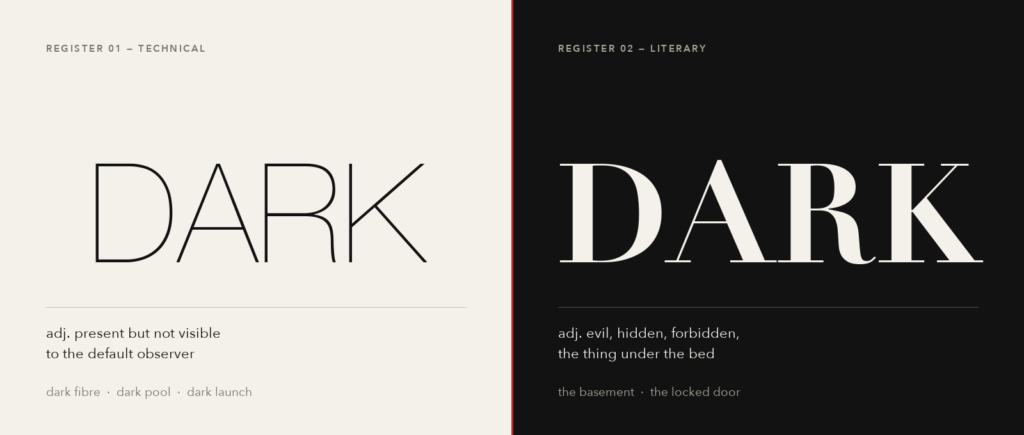
Ask anyone who has signed a telecoms contract what “dark fibre” means and you will get a shrug. Ask them what “the dark web” means and you will get a look.
Same adjective. Two entirely different jobs.
That is the puzzle in miniature. English has used “dark” to mean present but not visible to the default observer for decades — in contracts, in trading, in software engineering — and nobody found it sinister at all. Then “dark web” arrived carrying the other meaning of the word, the literary one, and the two ran straight into each other.
What follows is not a plea for pedantry. It is an attempt to explain why one four-letter word now does two opposite jobs, and why that matters more than it sounds.
One word, two registers. The technical sense is about light; the literary one is about dread.
The register that isn’t sinister
Start with what “dark” means in infrastructure. It means unlit. Or unlisted, unseen, not yet announced. In every case the word is making a claim about observability — about who can see the thing, and when — and in every case it says nothing at all about legality.
This is not a niche usage. It is the dominant one in several industries, and it is old.
Dark fibre
A telecoms operator lays more cable than it immediately needs. The strands that are installed but not connected to anything are dark: physically in the ground, owned, maintained, and not carrying light.
Companies buy and sell it. It appears in balance sheets and in wholesale agreements. In Britain, the alternative network builders that have spent a decade digging up pavements — CityFibre and its many smaller peers — sell capacity on precisely this basis, and Openreach offers unlit products of its own.
None of it is illicit. Dark fibre is what infrastructure looks like before it is switched on, and buying it is how a new provider reaches a market without building from scratch.
Dark pools
A dark pool is a private trading venue where orders are not displayed before they execute.
The opacity is the product. A pension fund wanting to move a large position cannot advertise that intention without moving the price against itself, so a dark pool lets it trade without showing the order first. In the United States these venues operate as alternative trading systems under SEC rules. In Britain and the EU they sit under MiFID II, with the FCA supervising how much trading may happen in the dark, and in which instruments.
You can object to dark pools on market-structure grounds. Plenty of people do, and the argument is worth having. But nobody calls them criminal enterprises, because “dark” here means without pre-trade transparency, not concealed from the law.
Dark launches, dark traffic, dark social
The same pattern runs through software and analytics.
A dark launch is a feature shipped to production but switched off for users, so a team can watch how it behaves under real load before announcing it. The code is live. Only the visibility is withheld.
Dark traffic is the visits your analytics cannot attribute because no referrer arrived with them: someone pasting a link into a messaging app, or typing a URL from memory. The cousin term, dark social, was coined around 2012 to describe sharing that happens where analytics cannot see. Again, no wrongdoing. It is a measurement gap.
Five terms, one adjective, one consistent meaning. The thing exists, and the default observer cannot see it.
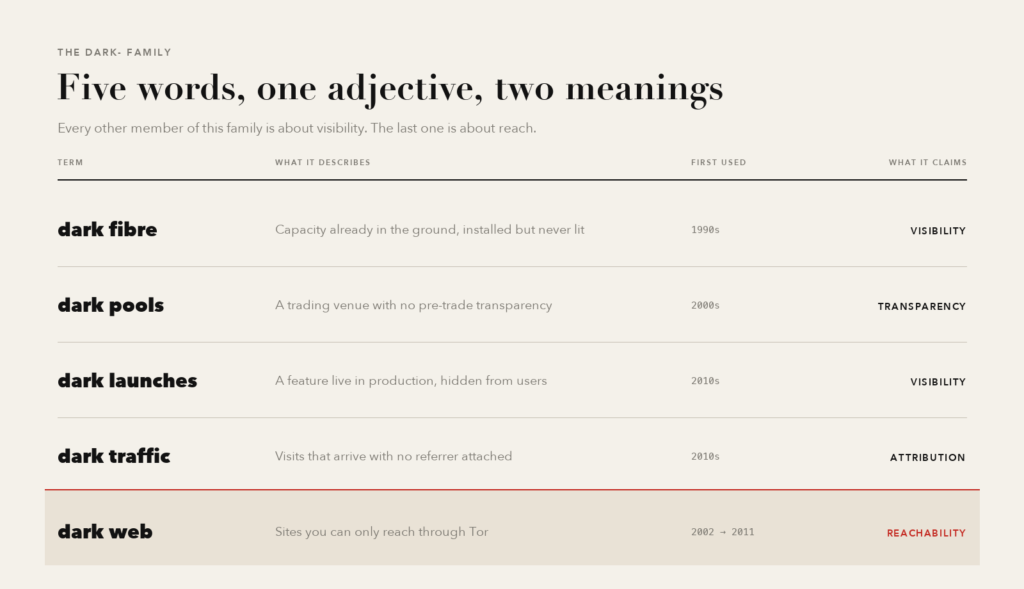
Four claims about visibility, one about reach. The last row is the one that changed the family.
The exception, and the odd cousins
One member of the family does carry a genuine moral charge, and it is worth naming so that the argument does not overreach. Dark patterns are interface designs built to trick you: a subscription that cannot be cancelled without a phone call, a consent box that arrived already ticked. There the word is unambiguously critical. It means deceptive by design.
But notice what changed. Dark patterns are a claim about intent and effect, made about a human decision. Dark fibre is a claim about light. The adjective is doing different work again, in a different direction.
The wider family is just as untidy. Dark sky describes a place with little light pollution — a compliment. Dark tourism describes travel to sites of death and disaster — ethically fraught, but a neutral descriptor of the activity. Dark matter is neither visible nor sinister.
The member that doesn’t fit
Then the internet acquired a “dark” of its own, and the family gained a relative that does not behave like the others.
The dark web is the set of sites reachable only through an anonymity overlay, chiefly Tor. It is not unlit or undisclosed in the way dark fibre is. It is reachable only by a particular route, at addresses that ordinary browsers cannot resolve, using a routing method built so that no single relay knows both ends of a connection.
That is a different kind of claim. Dark fibre, dark pools, dark launches and dark traffic all describe things that exist but are hidden from a default view. The dark web describes something whose visibility was never the point; its reach is. You cannot wander into it by accident. You need the right software and a 56-character address.
The categories do not nest neatly, and that is the trap the phrase sets. It is also, frankly, why the phrase won: two words, both of them short, one of them doing an enormous amount of emotional work for free.
A useful test, whenever you meet a claim about “the dark web”: what is the writer actually asserting? That a search engine cannot index it? That special software is required? That a network routes traffic unusually? Usually the writer has not decided, and neither has the reader.
Why the one-word version will not die
There is a spelling argument attached to all this, and it is more revealing than it first looks.
Edited prose writes it as two words, which is the convention in most British newsrooms and the safer choice, because it keeps the modifier visibly attached to the noun.
But a very large number of people search for darkweb as a single word, and that form has its own logic. URLs cannot contain spaces. Character limits punish them. English compounds have a long history of closing up once a phrase starts to feel like one object: web site became website, electronic mail became email, on line became online.
The single word is what happens when a phrase stops being two ideas and becomes one thing in a reader’s head. It is less a mistake than a symptom. It tells you that people have stopped hearing “a web that is dark” and started hearing a proper noun — which is also how it acquired capitals in headlines, and why it now gets written as though it were a place you could visit, rather than a set of protocols and address formats.
Where the confusion costs something
Three places.
Drafting. When a parliament legislates about “the dark web”, it has to decide what it is regulating. Sites reachable through an overlay? The overlay protocol itself? Marketplaces hosted on it? Those are three different laws. The Online Safety Act, with Ofcom now enforcing it, had to work hard to specify whether it covers content, services, protocols or networks. Getting the vocabulary right is the first step to getting the scope right. A fuzzy word produces fuzzy law.
Reporting. A story saying a company’s data turned up “on the dark web” usually describes something much duller: a credential dump traded on a forum. The phrase adds drama and subtracts information. “Leaked passwords were being sold on a criminal forum” is more accurate and more useful.
Privacy. This one matters most and is discussed least. If dark can only mean criminal, then a reader who wants to keep their email out of strangers’ hands has no vocabulary for what they are doing. They are not on the dark web. They are using the deep web — which is where their bank, their doctor and their employer already live, and always have. A vocabulary that makes ordinary privacy sound transgressive quietly discourages it.
A short ruling
Three rules will keep you accurate without making you dull.
- Use “dark” in its technical sense when describing infrastructure — dark fibre, dark pool, dark launch — and do not put it in scare quotes.
- Do not use “dark web” when you mean illegal marketplaces. Say illegal marketplaces. It is longer, and it is the thing you mean.
- When you meet the one-word form, treat it as information about the writer’s audience rather than a crime against style. Somebody typed darkweb because the thing in their head is one object. The useful reply is to explain what that object is, not to correct the spelling and leave them with the same fog.
The word never meant evil. It meant unlit. Somewhere in the last fifteen years we stopped saying so.
