
Previously, quantity takeoffs in the field of construction could only be performed by means of rulers, markers, and numerous drawings on paper. Quantity estimators had to spend a lot of time tracing lines and counting elements to write their estimates down in spreadsheets of electronic nature. Mistakes could easily occur at every step of the way. Today, however, thanks to digital quantity takeoff, most of the work is being done automatically. Employees perform their work with the help of PDFs, CAD, D and 3D models, and measurements are taken in just a few moments and are automatically updated if anything changes in design. The result is delivered much quicker and much more accurately.
The significance of the change lies in the fact that, in the contemporary world, the bidding process determines the winner of a contract and helps them keep their margins safe.
The Change from Hand-Drawn Measurements to Digital Ones
Construction Estimating Services previously required each estimator to constantly measure the drawings in the same way. Mistakes, missing layers, and repeating the measurements were common problems. These problems have been largely overcome through digitalization. An estimator only needs to open the drawing or model and designate the needed area or distance, and then the program will show the measurement immediately. It is linked with the drawing, allowing referring to it whenever you need.
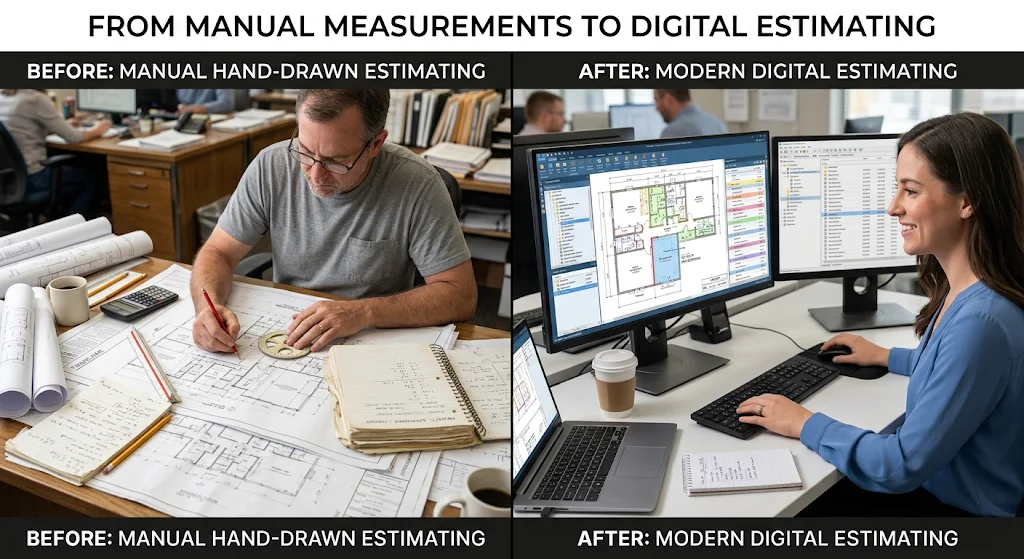
Teams that used to spend days doing a takeoff for a medium-sized commercial project can do it in a couple of hours. It allows estimating more projects without hiring new people. Additionally, digitalization allows creating a traceable document. In case of any doubts while doing bidding leveling, one can always rely on the original drawing.
This method of estimation appears due to the large number of companies using their available internal resources. The external specialists do the digital takeoff, provide the quantified data divided by trades, and provide the information that is used for estimation purposes. The decision about the final number is made by the contractor, but much faster.
The consistency is the unique feature of the process. Two specialists working with the same calibrated information and the same assembly definitions calculate almost identical numbers. Such a thing was impossible to reach using manual methods. Another unique feature of the process is the opportunity to change the drawing without starting the entire procedure from scratch. With the help of an addendum, the software will show all changes and quantify only the changed part.
How Precision Affects the Result of the Bidding Process
The accurate numbers become the basis of every bidding process. There will be no errors in the numbers; therefore, the rates provided above will look quite reasonable. There will be no need to include any contingency.
Studies indicate that digital takeoffs are capable of reaching the accuracy of 95 percent or more with respect to properly prepared drawings, compared to the much wider variation of traditional methods. Variance from actual values in costs may be reduced to 3-5 percent instead of the usual 12-18 percent. Considering the millions of dollars at stake, this difference makes all the difference between success and failure of a project.
It is exactly what distinguishes the importance of the present article. Digital estimating is not just a technical matter. It is an effective instrument to impact the performance and success of a project. Firms understanding the nature of measurement as exact science submit bids with high certainty and undertake projects with fewer surprises.
For improvement of the accuracy of takeoffs, one has to calibrate each group of drawings before starting work, use standard assemblies for repeated components, and compare expensive components to some other method or previously undertaken project. Make a list of materials used in the completed projects and compare it to the initial takeoff. Every extra or missing component will become immediately visible.
Direct Integration of the Models with the Cost Information
A 3D model is not just a set of geometric shapes; each wall, beam, duct, or fixture has information stored about the type of material used, thickness, and classification. If the model was created correctly, the quantities will be easily extractable from the schedules or other tools and will change along with the design.
BIM Modeling Services provide the opportunity to create or clean the models so that they can be measured with confidence. A good-quality model would eliminate the need to interpret 2D drawings and would allow having only one document for estimation that would be used by multiple disciplines.
The advantage will be immediately seen when working on complex projects. Although the simple fit-out project does not need modeling, the multiple-floor commercial buildings or campus will greatly benefit from it. Quantities of the concrete, steel, drywall, and MEP systems are all updated simultaneously as the design changes; the estimation team does not waste time updating the information but analyzes cost alternatives.
The characteristics of the model-based measurement include the usage of object-level data, filtering capabilities either by system or floor, and trade package creation that allows contractors to analyze the package using graphical capabilities. Professional judgment should be used anyway. The model is never created completely on the first day. The estimators should evaluate how complete it is, take into account such things as formwork or temporary works, and use proper measuring methods.
Benefits of Digital Quantity Measurement for Project Teams
There are other benefits of digital quantity measurement apart from the estimate itself. The material lists become clearer for field workers. The procurement team orders the materials according to the real demand. The project manager tracks the progress of the project against the baseline, which is already known to be correct. When the bids from the subcontractors are received, the general contractor gets its own quantities.
List of points illustrating the practical benefits:
Quicker turnarounds for bid invitations and addenda
Less likelihood of underbidding or overbidding material quantities
Improved record keeping for subsequent claims or value engineering negotiations
Simplified teamwork for situations where multiple estimators need to estimate the same package.
Elimination of unnecessary waste through overordering or last-minute emergency ordering
These benefits are cumulative. Not only does an accelerated takeoff process result in more bids being made, but accuracy ensures that more of the winning bids will result in profitable projects. In the end, one year sees significant improvements in both the quantity and profit margins of bids.
Scaling Benefits for Differing Levels of Complexity in Projects
Small projects see efficiency and lower overhead. Medium-sized commercial projects see consistency across multiple estimators. Large and complex projects see the ability to deal with many changes in design without having to redo the measuring. All of these projects use the same technology platform; only the size of the model varies.
An example of scaling value appears when a contractor moves from one-off jobs to a program of similar buildings. The assemblies and measurement templates created for the first project transfer to the next ones with only site-specific adjustments. Learning compounds instead of resetting with every new drawing set.
Real-World Estimation Walkthrough
Consider a mid-duration enterprise corporation place of job interior of about 25,000 rectangular feet. The package deal consists of demising partitions, ceilings, flooring, doors, and electrical power. Under a traditional method, the takeoff might also take several days. With virtual system, the identical artwork result in three to four hours, as speedy because of the truth the drawings are calibrated.
Here is a simplified estimate for part of that scope (numbers are illustrative and based mostly on typical mid-range commercial expenses):
| Item | Quantity | Unit | Unit Rate | Total |
| Metal stud partition (3-5/8″) | 4,200 | LF | $18.50 | $77,700 |
| Gypsum board, all additives | 18,900 | SF | $2.85 | $53,865 |
| Acoustic ceiling tile | 22,500 | SF | $4.20 | $94,500 |
| Carpet tile | 18,000 | SF | $6.75 | $121,500 |
| Solid core doors with frames | 48 | EA | $850.00 | $40,800 |
| Electrical receptacles | 185 | EA | $95.00 | $17,575 |
| Lighting fixtures (LED) | 210 | EA | $145.00 | $30,450 |
| Subtotal (Selected Items) | — | — | — | $436,390 |
The digital tool produced the portions proper from the plans. The estimator then calculated modern network expenses and took in tough artwork, markup, and contingency. Because the measurements had been regular and associated again to the drawings, the team had to remedy the owner’s questions about scope fast and alter for price-engineering alternatives without re-measuring the entirety.
Commercial Electrical Estimating fits into the later levels of this workflow. Once the architectural and structural portions are sturdy, the electrical takeoff can run from the identical drawing set or from a coordinated model. Counts of devices, lengths of conduit and wire, and fixture schedules emerge as dependable inputs in preference to break up guide efforts.
Advice for Starting to Work with Digital Technology
Use the drawings you have at the moment in your reports. Obligations within the present day period appear in the form of PDF documents. Choose a software application that allows you to deal with calibration, space and distance calculations, and effortless exporting into spreadsheets. Educate a minimum of one estimator earlier than introducing the approach all through the institution. Make a small checklist of items to do while you receive new drawings: verify the scale, examine for missing pages, and remember about cloudy revisions.
Include human assessment in your technique. Even as digital gear helps to avoid miscalculations and transcription mistakes, it cannot decide if the kind of wall suits the requirement or if a short form is needed. Skilled judgment is still essential.
Control the result. Compare the consequences of digital takeoffs with real fabric invoices in the first couple of completed tasks. Modify assemblies and waste parts using only real facts. The machine gets better after every use.
Conclusion
Digital quantity take-offs have changed from an advantage to a necessity as a result of the issue of competitive bidding. This will reduce the process from drawings to costed concept and will help the contractors have a better perception of risk before time than they do. The companies that see size as a controlled virtual system rather than a tool will gain even more margins for the projects they select.
This change doesn’t remove the need for professional estimators. This enables them to focus on assessment, technique, and communication instead of being a repetitive counter. In a firm where the margins are normally thin, and there is always competition, the reputation change is surely worth it.
FAQs
What is the main difference between virtual and conventional quantities?
Virtual takeoff is instant from calibrated drawings; all calculations are automated, and conventional takeoff requires manual scaling and data entry. Virtual takeoff is much faster, more accurate, and needs much less time to be updated along with drawings.
How accurate is the virtual takeoff during performance?
For clear and well-prepared drawings, virtual takeoff can reach 95% accuracy or even more. The biggest source of inaccuracy is connected with incomplete models, lack of fast artwork,rk and interpretations of specifications according to the scale.
Is it possible for smaller contractors to use virtual takeoff?
Yes. Even small contractors who place only a few tenders per month will save time and avoid mistakes. Small contractors start with PDF takeoff tools and move to versioned ones, which are absolutely different in approach, as the volume of work increases.
Does virtual takeoff eliminate the need for professional expertise?
No. Tools allow automating calculations and providing consistency, but estimators are responsible for deciding what to include in quantities, how to interpret time codes,s and how to account for real-life situations that might not be reflected on drawings.
