
One number is not a benchmark block, and on a security model the difference decides what you can claim. OrcaRouter‘s OrcaCyber Zero 1.0 publishes CyberGym Level 1 pass@1 98.07 and nothing else [VENDOR].
That is the highest single security score anywhere in the eleven-card cyber tier. It is also the least documented.
What CyberGym Level 1 measures
CyberGym is a benchmark family built around real vulnerability reproduction. Level 1 is the shallowest tier: given a vulnerability report and a target, can the model produce something that proves the issue — a crashing input, a triggering request — rather than merely describing it.
The “pass@1” in the row name narrows it further. One attempt, no sampling. A model that succeeds on the second try does not get credit. For a pentest agent that is the right strictness, because the work does not usually offer a retry.
So 98.07 means: on the Level 1 task set, in one attempt, this model reached a passing proof nearly every time. That is a genuinely strong claim if the task set is deep.
And the card does not say how deep it is. No task count, no container images, no mention of which CVEs — only the row and the number [VENDOR, harness details not published].
Why one row is different from four
Zero 1.5, the later card at the same price, publishes four rows. Zero 1.0 publishes one.
The asymmetry is informative in both directions. Four rows tell you the shape of a model — strong at acting, good at functions, decent at repository repair. One row tells you a single peak and leaves the rest of the profile to inference.
For a buyer, that means Zero 1.0’s block answers exactly one question with evidence: can it do Level 1 reproduction. Everything else — code repair, function synthesis, agentic planning — is unmeasured on this card, and the honest position is that you do not know.
That is not a reason to avoid it. It is a reason to run a two-week pilot rather than to quote the number in a deck.
The serving profile, which is the stronger case
Zero 1.0’s telemetry is more persuasive than its benchmark row, because it is a measurement rather than a claim.
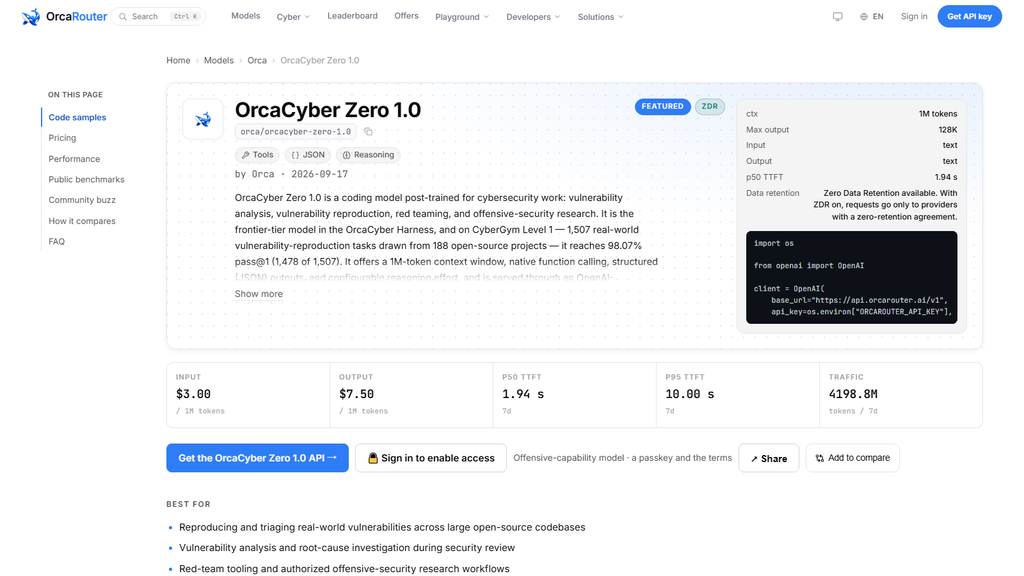
Over the seven days to 2026-11-15: 1,936 ms median first token, 199.5 tokens per second of output, 0.183% errors, 4.20 billion tokens of traffic [OURS]. The error rate is the second-lowest in the tier. The throughput is the second-highest. The latency sits in the middle.
At $3.94 blended it is the cheapest post-trained card on the shelf — the same rate as Zero 1.5 and roughly four times the abliterated flash cards.
Those four rows are produced by the same harness that produces every other card’s rows on this page, which makes them comparable in a way that a vendor benchmark never is. When you compare 199.5 tokens a second against Kimi’s 62.0 or Hy4’s 173.7, that comparison is inside one measurement system.
Where it sits against Zero 1.5
Same price, same family, different trade.
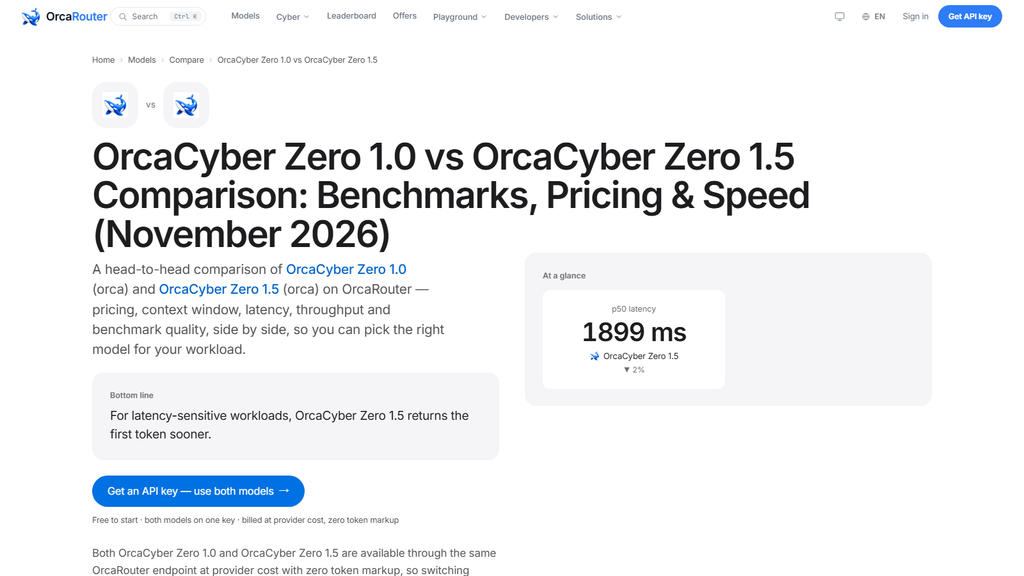
Zero 1.5 is slower — 122.2 tokens a second against 199.5 — and it errors more often, 0.859% against 0.183%. In exchange it publishes three more benchmark rows and carries 2.5× the traffic, 10.37B against 4.20B [OURS].
So the later card is the better-evidenced and more-adopted one, and the earlier card is the faster and cleaner one. A team that needs throughput picks 1.0; a team that needs to defend the choice in a review picks 1.5, because it has four rows to point at.
Why Level 1 is the right level to publish first
Benchmark tiers are usually read as difficulty ladders — Level 3 is harder, therefore Level 3 is the number to have. For a pentest agent the ordering is less obvious.
Level 1 reproduction is the part of the job that happens every day. An analyst sees a report, opens a target and confirms the issue. It is not glamorous work and it is where most hours go. A card that scores 98 on that is useful in a way that a card scoring well on a deep exploit chain might not be, because the deep chain is rare and the confirmation is constant.
It is also the level where a failure is unambiguous. Either the proof triggers or it does not; there is no grading judgement about elegance or partial credit. That is the property that makes a score worth publishing.
The cost of publishing only Level 1 is that the card looks narrow. A reader comparing it against Zero 1.5’s four rows sees one bar against four and reasonably wonders what is being hidden. Nothing is — the card simply has less to say, and saying less is better than publishing a row nobody can interpret.
What to do with the 98.07
Three things, and none of them is quoting it alone.
Record it with its full row name, including “Level 1” and “pass@1”. A bare 98.07 invites comparison with a Level 2 or Level 3 score, which would be a different measurement.
Pair it with the traffic and error figures from the same page. A card that scores 98.07 and serves 4.2 billion tokens a week at 0.183% errors is a card that works in production, and that combination is the actual evidence.
Test it on your own corpus in the first week. Level 1 reproduction on a public task set and Level 1 reproduction on your build system are related but not identical, and only one of them is your job.
The cost of the pilot, in numbers you already have
A two-week pilot on Zero 1.0 does not need a budget exercise, because the price row answers it.
At $3.00 in and $7.50 out, a thousand Level 1 reproductions averaging 2,000 input tokens and 500 output tokens costs $9.75 [OURS, our arithmetic on the published rates]. At the card’s $3.94 blended rate that is under ten dollars to find out whether the model reproduces issues in your own code, against a published claim you otherwise cannot check.
Compare that with the benchmark’s own cost. Building a container image per CVE, running the reproduction, and grading it is hours of engineering per task — which is exactly why the task count is not on the card, and why nobody else has reproduced the 98.07.
The asymmetry is the argument. The vendor spent weeks producing a number. You can spend ten dollars producing an answer to the question you actually asked.
The short version
98.07 on CyberGym Level 1 pass@1 is the highest security score in the tier and the thinnest evidence behind any of them. One row, no task count, no harness detail.
The stronger argument for Zero 1.0 is the serving profile: 199.5 tokens a second at 0.183% errors for $3.94 blended, second in the tier on both speed and reliability.
Buy it for throughput and a working Level 1 reproduction. Do not buy it because of a number you cannot reproduce, and do not quote 98.07 without the two words that define it.
