
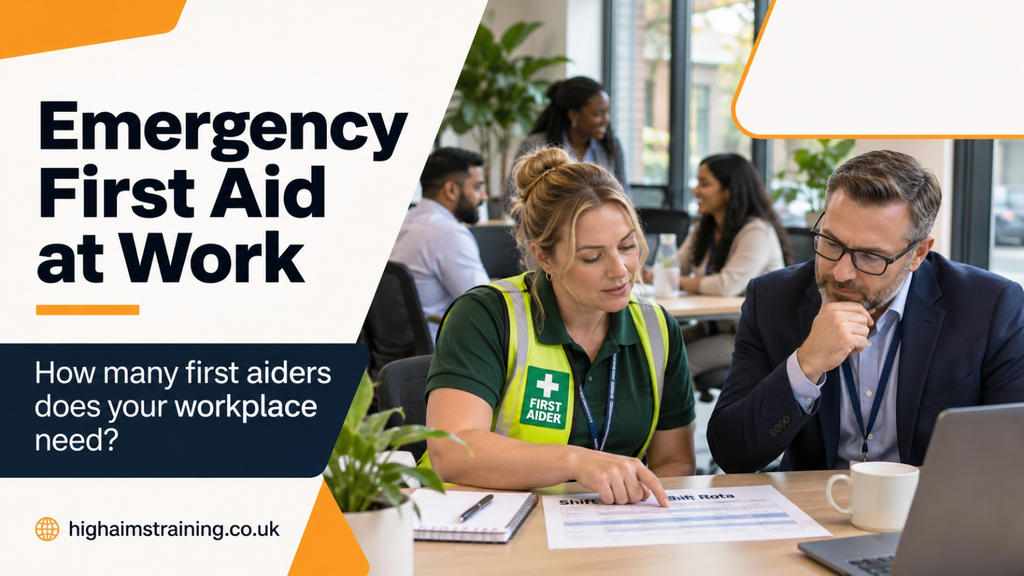
Friday, 5.10 pm. A member of staff cuts their hand in the stockroom. The first aid kit is within reach, but the only trained first aider went home ten minutes ago. On paper, the business has cover. On the late shift, nobody knows who can help.
How many first aiders does your workplace need? There is no single number set in UK law. Every employer must assess its first aid needs, and the Health and Safety Executive (HSE) gives suggested starting points. For example, a lower-risk office with 25 to 50 employees present should have at least one person trained in Emergency First Aid at Work (EFAW). A higher-risk workplace with more than 50 employees should have at least one fully trained first aider for every 50 people.
Those figures are where you start, not where you stop. To work out how many colleagues to train, look at the risks your team faces and check who is actually there when people open up, work late or cover a holiday.
What does UK law require?
Under the Health and Safety (First-Aid) Regulations 1981, every employer must provide adequate and appropriate first aid equipment, facilities and people, so staff who are injured or fall ill at work get help quickly. The rules apply to every workplace, including businesses with fewer than five employees and the self-employed.
Employers must also carry out a first aid needs assessment. It looks at the hazards of the work, the size of the team and any other factors that affect how quickly help can arrive. The law does not cover members of the public, but HSE strongly recommends including them in your assessment. You can read the rules on HSE’s first aid pages.
Two roles come up again and again:
- An appointed person looks after the first aid kit and arrangements, and calls the emergency services when needed. The role needs no formal first aid qualification.
- A first aider holds a current first aid qualification suited to the workplace, such as Emergency First Aid at Work (EFAW) or First Aid at Work (FAW).
How many first aiders do you need per shift?
HSE gives the following suggested starting points. Use the number of employees present on each shift, not your total headcount.
| Workplace risk | Employees present | Suggested minimum cover |
| Lower risk (offices, shops, libraries) | Fewer than 25 | At least one appointed person |
| Lower risk | 25 to 50 | At least one EFAW-trained first aider |
| Lower risk | More than 50 | At least one FAW-trained first aider for every 100 employees, rounding up |
| Higher risk (warehouses, workshops, construction, food processing) | Fewer than 5 | At least one appointed person. The work may still call for a trained first aider. |
| Higher risk | 5 to 50 | At least one first aider trained in EFAW or FAW, depending on the injuries that could happen |
| Higher risk | More than 50 | At least one FAW-trained first aider for every 50 employees, rounding up |
The table tells you how many first aiders should be available at once. How many employees you need to train is a separate question. It must allow for breaks, days off, sickness and annual leave, so the required cover is still there throughout the working week.
What changes when a team grows from 50 to 51?
In a lower-risk office with 50 employees present, the suggested starting point is one EFAW-trained first aider. At 51, the number stays at one, but the suggested qualification changes to the broader FAW. In a higher-risk warehouse with 51 employees present, the starting point becomes two FAW-trained first aiders. Check your figures again whenever you recruit, merge shifts or change the work people do.
When is Emergency First Aid at Work suitable?
Emergency First Aid at Work is suitable when your needs assessment shows that staff need someone who can respond to common workplace emergencies until an ambulance arrives. Start by reviewing the tasks employees carry out, the equipment and substances they use, and the injuries recorded in your accident book.
Consider the workplace itself too. Separate buildings, restricted access, lone working and distance from emergency services can all affect your arrangements. A small headcount alone does not prove that an appointed person is enough. Where the work carries particular risks, describe them to the training provider and ask which ones the course covers.
EFAW vs FAW at a glance
| Emergency First Aid at Work (EFAW) | First Aid at Work (FAW) | |
| Course length | 1 day | 3 days |
| What it covers | Life-threatening emergencies: CPR, defibrillator use, choking, serious bleeding, unresponsive casualties | Everything in EFAW, plus a wider range of injuries and illnesses, such as suspected fractures and spinal injuries |
| Usually suits | Lower-risk workplaces with 25 to 50 staff, and smaller higher-risk teams where the assessment allows | Larger teams and higher-risk work such as warehouses, workshops and construction sites |
| Certificate lasts | 3 years | 3 years |
If your assessment points to FAW, High Aims Training also runs the three-day First Aid at Work course.
How do you work out how many employees to train?
Use your staff rota to turn the HSE guidance into a training decision. Check a full working week and at least one planned absence.
- List the hours people work. Include opening and closing duties, overtime, weekend shifts and cleaning. Note where each team works if staff are spread across floors or buildings.
- Add the trained people available. Check each person’s usual hours, work location and certificate expiry date. Include time spent working from home or visiting other sites.
- Check breaks and planned leave. Mark any period when the required cover is missing. This shows which days, shifts or parts of the building need attention.
- Train employees who fill those gaps. Choose colleagues who are willing to take on the role and usually work during the hours you identified. Then tell all staff who they are and how to reach them.
Your accident book is a useful second check. If staff have cut their hands while cleaning equipment at closing time, make sure a trained first aider works that shift. Training a colleague who always leaves before cleaning starts would leave the evening team without cover.
What does the one-day EFAW course cover?
Learners practise assessing a casualty, calling for help and giving immediate care while waiting for the emergency services. The course covers:
- CPR and using an automated external defibrillator (AED)
- Helping someone who is unresponsive, including the recovery position
- Choking
- Serious bleeding and shock
- Minor injuries such as small cuts, burns and scalds
Practical exercises give learners time to demonstrate these skills and get feedback from a trainer.
High Aims Training runs the Emergency First Aid at Work course at its training centre in Ilford, London, as a blended option: three hours of online learning followed by three hours in the classroom, including the practical assessment. Before choosing a date, check when the online part must be finished, and arrange cover for the time your employee will be away. Check Emergency First Aid at Work course details and available dates.
Frequently asked questions
Is it a legal requirement to have a first aider at work?
Every employer must make adequate first aid arrangements and carry out a first aid needs assessment. In a small, lower-risk workplace, an appointed person may be enough. Where the assessment shows a need for trained cover, you must have qualified first aiders available.
Can an appointed person cover a first aider’s holiday?
If your assessment requires a trained first aider, arrange qualified cover for planned holidays. HSE allows an appointed person to step in during an unexpected absence. Annual leave is foreseeable, so check who will be available before approving overlapping holidays.
Can employees complete EFAW training entirely online?
No. A regulated EFAW qualification includes practical training and an assessment in person. Employees can study some theory online as part of a blended course, but they must attend the practical session and show their skills.
How long does an Emergency First Aid at Work certificate last?
An EFAW certificate lasts three years. HSE strongly recommends annual refresher training to help first aiders keep skills they may rarely use. Record each expiry date and book requalification in good time. Staggering bookings helps keep trained cover in place while colleagues renew.
Do you count customers when deciding how many first aiders a shop needs?
HSE’s suggested numbers refer to employees. However, HSE strongly recommends considering customers and other visitors when you plan first aid. On a busy Saturday, would the colleague on the shop floor know how to get help for a customer who collapses at the till?
Is EFAW enough for a construction site?
It depends on your assessment. Construction is higher-risk work, so larger sites usually need FAW-trained first aiders, and some hazards need extra training. EFAW can be suitable for smaller teams where the likely injuries are covered by the course.
What should staff know about first aid at work?
Every employee should know who the first aiders are, how to contact them and where to find the first aid kit. Explain the arrangements when someone joins, and update staff when names, shifts or locations change. Keep contact details where people can see them on every shift.
Make sure every shift is covered
The right number of first aiders is the number that keeps every shift covered, not just the busiest one. Check your rota against the HSE table, fill the gaps, and book training before certificates expire. To get your team qualified in a day, book Emergency First Aid at Work with High Aims Training.
